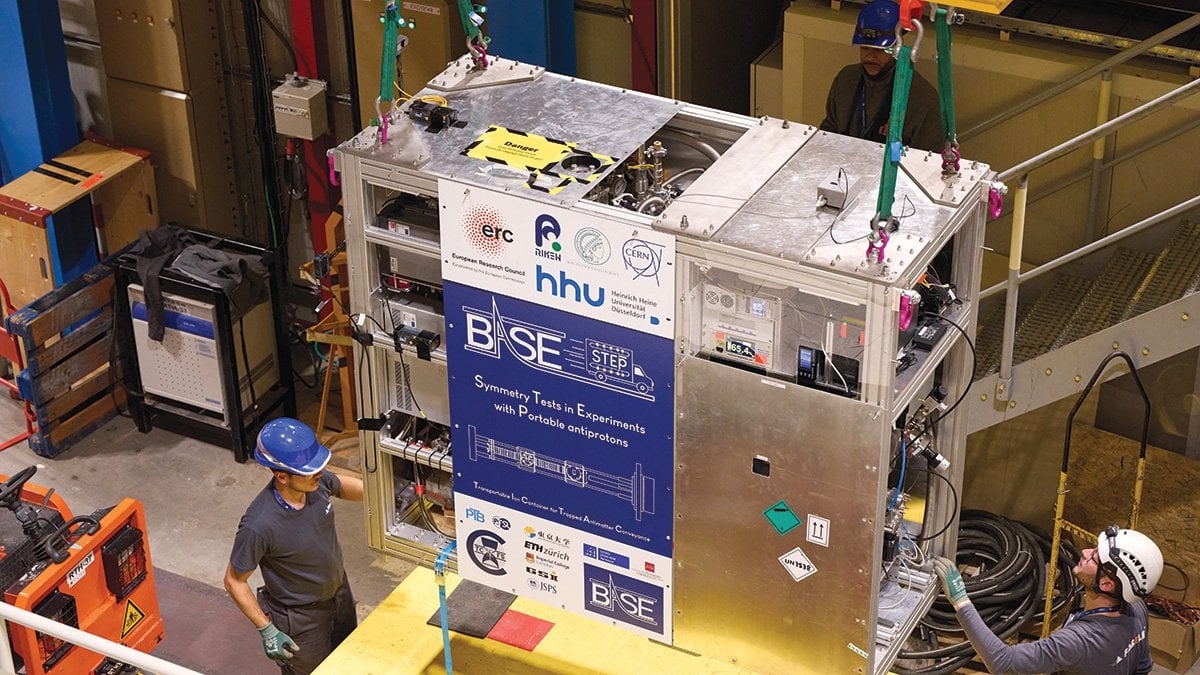
Trial trap on a truck – The ultimate goal is to deliver antiprotons to labs beyond CERN’s reach.
https://cerncourier.com/a/trial-trap-on-a-truck/

Trial trap on a truck – The ultimate goal is to deliver antiprotons to labs beyond CERN’s reach.
https://cerncourier.com/a/trial-trap-on-a-truck/
6 Comments
From the article
>Antimatter needs to be handled carefully, to avoid it annihilating with the walls of the trap. This is hard to achieve in the controlled environment of a laboratory, let alone on a moving truck. Just like in the BASE laboratory, BASE–STEP uses a Penning trap with two electrode stacks inside a single solenoid. The magnetic field confines charged particles radially, and the electric fields trap them axially. The first electrode stack collects antiprotons from CERN’s antimatter factory and serves as an “airlock” by protecting antiprotons from annihilation with the molecules of external gases. The second is used for long-term storage. While in transit, non-destructive image-current detection monitors the particles and makes sure they have not hit the walls of the trap.
>“We originally wanted a system that you can put in the back of your car,” says Smorra. “Next, we want to try using permanent magnets instead of a superconducting solenoid. This would make the trap even smaller and save CHF 300,000. With this technology, there will be so much more potential for future experiments at CERN and beyond.”
And suddenly I realize I’m not reading an ELI5 comment.
Portable antiprotons ?
I´m a caveman!
Joke aside, this really puts into perspective the level of science done and technology developed these days, still no “real” Hoverboard , okay, I´ll stop complaining .
I look forward to branded anti protons and seeing “we have anti protons at home” memes in the 2050s
Antimatter annihilates itself and matter when they come into contact. This thing could go boom, no?
Just need some dilithium crystals to channel the plasma to the warp coils, and Bob’s your uncle.