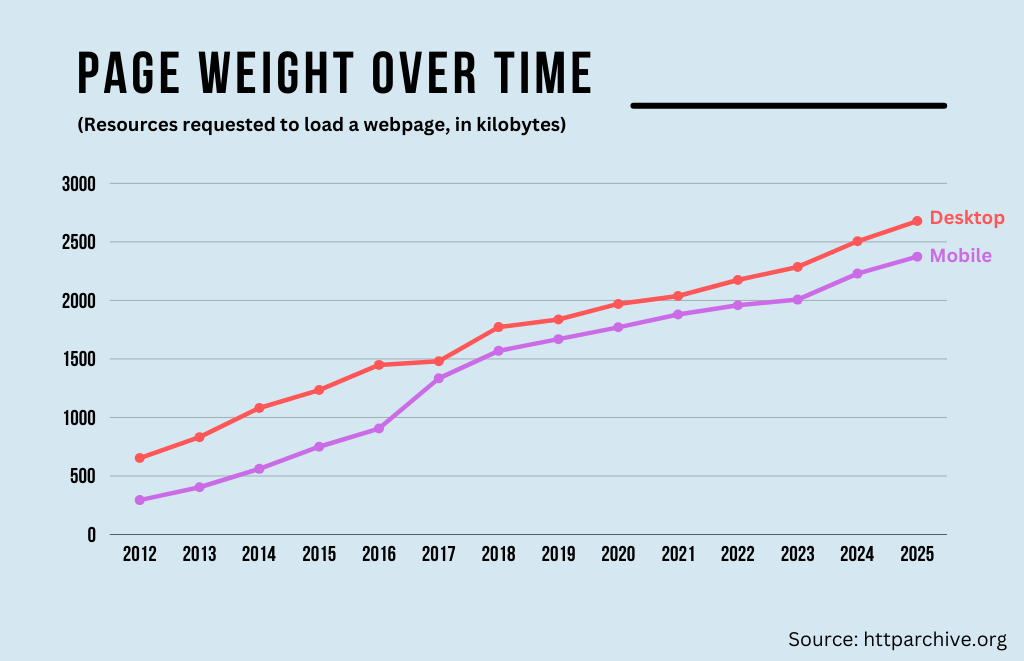
Wish this went further back so the massive jump resulting from broadband was visible.
Definitely a great example of how software always bloats to negative any increase in hardware.
LSeww on
it’s not just that, time to load has been constant since like 2000s despite speed and processing power increasing exponentially
wardrox on
You got a faster computer? Don’t worry I can fix that.
ZipTheZipper on
How much of that is ads and trackers?
staplesuponstaples on
Wirth’s Law states that software’s bloat outpaces hardware’s acceleration.
WillyTRibbs on
Would love to see this split by media/images/graphics/videos vs. code resources/scripts.
timpdx on
I remember the days when the goal was an under 100kb home page.
2006pontiacvibe on
A lot of this really is just ads. Open a news website without an adblocker and literally 2/3 of the page is giant video ads that make the whole page stutter while scrolling. Add a billion popups like newsletters and adblock blockers and any website will be slow.
scraperbase on
That is good news for me, because I hate it if a search engines punishes my site just because the main page is a megabyte or so big or I still use JPEGs instead of those annoying WebP images. In times of video streaming is it really a problem, if a website needs a few megabytes to load?
johnnyk8runner on
Website and game designers don’t even seem to attempt to manage resources
FandomMenace on
It’s all ads. The worst part is that the actual words are all ai slop placed as a premise to sucker you into loading the page so they can get ad money.
chicknfly on
Something I’m not seeing discussed here all that much is the correlation to increased use of cloud computing resources vs on-prem alongside asynchronous calls.
I was working a full stack role on a project. There were tons of pages that would output a table, and there were dropdown menus containing filters for every column. Each filter involved an async call to dynamically populate its values. Each async call involved reaching a server hosted on an Azure VM which then called a separate Azure database. That VM call to the database would involve creating and closing a new connection with the DB every time. And since our clients were in BC and the specific Azure region we could use was in Toronto, each call had to go across the country.
Ya’ll, I’ve had tables take *minutes* to load. And they were paginated.

13 Comments
Wish this went further back so the massive jump resulting from broadband was visible.
Definitely a great example of how software always bloats to negative any increase in hardware.
it’s not just that, time to load has been constant since like 2000s despite speed and processing power increasing exponentially
You got a faster computer? Don’t worry I can fix that.
How much of that is ads and trackers?
Wirth’s Law states that software’s bloat outpaces hardware’s acceleration.
Would love to see this split by media/images/graphics/videos vs. code resources/scripts.
I remember the days when the goal was an under 100kb home page.
A lot of this really is just ads. Open a news website without an adblocker and literally 2/3 of the page is giant video ads that make the whole page stutter while scrolling. Add a billion popups like newsletters and adblock blockers and any website will be slow.
That is good news for me, because I hate it if a search engines punishes my site just because the main page is a megabyte or so big or I still use JPEGs instead of those annoying WebP images. In times of video streaming is it really a problem, if a website needs a few megabytes to load?
Website and game designers don’t even seem to attempt to manage resources
It’s all ads. The worst part is that the actual words are all ai slop placed as a premise to sucker you into loading the page so they can get ad money.
Something I’m not seeing discussed here all that much is the correlation to increased use of cloud computing resources vs on-prem alongside asynchronous calls.
I was working a full stack role on a project. There were tons of pages that would output a table, and there were dropdown menus containing filters for every column. Each filter involved an async call to dynamically populate its values. Each async call involved reaching a server hosted on an Azure VM which then called a separate Azure database. That VM call to the database would involve creating and closing a new connection with the DB every time. And since our clients were in BC and the specific Azure region we could use was in Toronto, each call had to go across the country.
Ya’ll, I’ve had tables take *minutes* to load. And they were paginated.
I told you JavaScript was a mistake.