
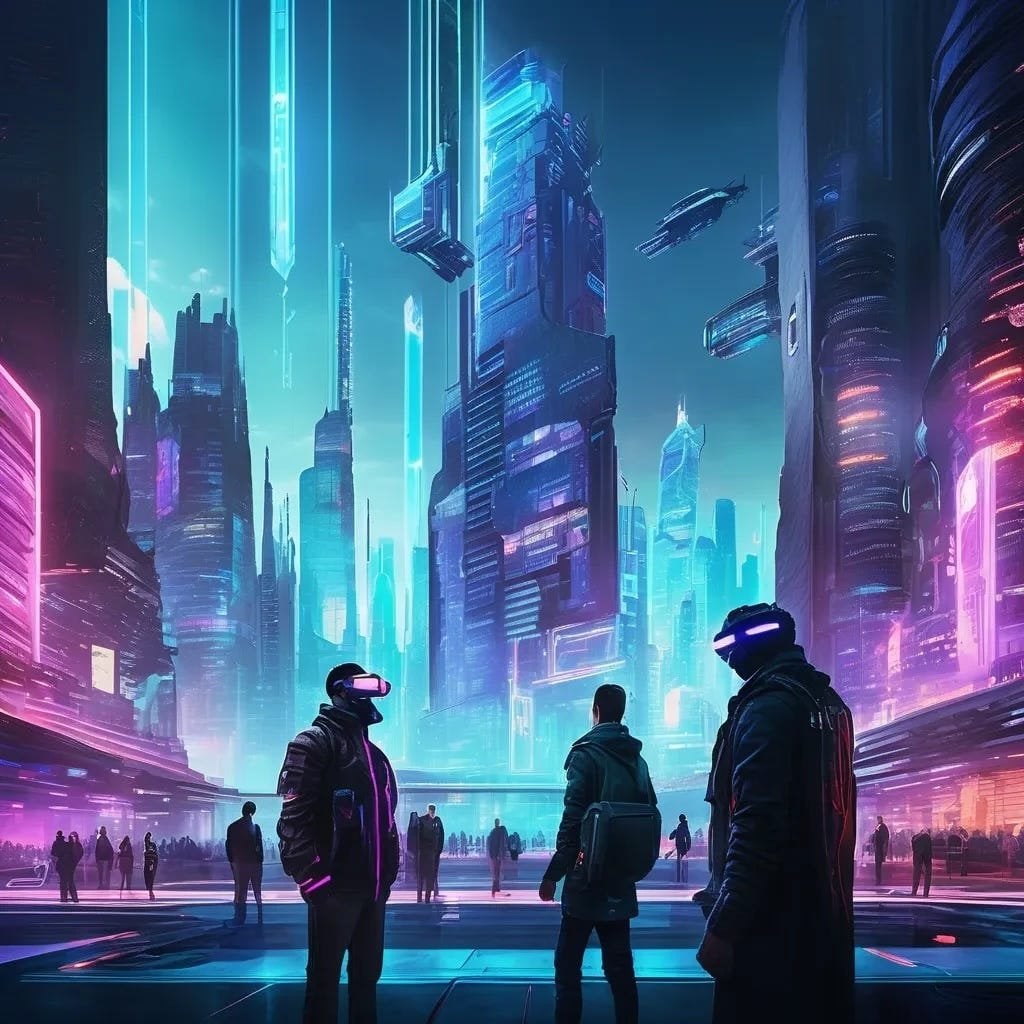
The tech broligarchs are the lords. The digital platforms they own are their “land.” They might project an image of free enterprise, but in practice, they often operate like autocrats within their domains.
Meanwhile, ordinary users provide data, content, and often unpaid labour like reviews, social posts, and so on — much like serfs who work the land. We’re tied to these platforms because they’ve become almost indispensable in daily life.
Smaller businesses and content creators function more like vassals. They have some independence but must ultimately pledge loyalty to the platform, following its rules and parting with a share of their revenue just to stay afloat.
Why on Earth would techno-feudal lords care about our well-being? Why would they bother introducing UBI or inviting us to benefit from new AI-driven healthcare breakthroughs? They’re only racing to gain even more power and profit. Meanwhile, the rest of us risk being left behind, facing unemployment and starvation.
—-
For anyone interested in exploring how these power dynamics mirror historical feudalism, and where AI might amplify them, here’s an article that dives deeper.
The future of a techno-feudalist society is dark
byu/iamuyga inFuturology
12 Comments
We should do a french revolution as long as we still CAN.
That’s why Elon calls it Dark Maga. He’s not joking. He’s literally telling you what he’s going to do. And if you’re not familiar with this concept you need to look into who Curtis Yarvin is. That’s the “philosopher” Musk is following. Prepare to be chilled to the bone when you read what he thinks should happen to the poor “dead weight” of society.
Wait until Ai can do most jobs. Then there’s no need for the human parasites and we will be killed off because the humans will be more resource hungry than the robots/ai. That’s how they cure global warming and the environmental issues
We are heading towards all this shit that was going on in blade runner
All this because the average American is an idiot blinded by an equally idiotic Marktist ideology.
The United States has the potential to be the greatest communist nation in history, but it would rather be the literal Nazis of this century.
So it’s going to be like Cyberpunk 2077? I enjoyed that game a lot after a certain patch number!
I asked ChatGPT to define the key tenets of Techno-feudalism.
When I read it from top to bottom, I can say for sure that the US almost is one.
Here is what it had outputted:
“A techno-feudalistic society is a concept that describes a socio-economic system where traditional capitalist structures are replaced by a new form of digital feudalism, dominated by a small elite of tech overlords who control access to digital platforms, data, and AI-driven economies. Key tenets of this system include:
1. Platform Lords & Digital Serfdom
Instead of land-owning feudal lords, tech corporations and billionaires control key digital infrastructures (platforms, cloud services, AI models).
Workers and users become digital serfs, dependent on these platforms for income, productivity, and social interactions, with limited autonomy.
2. Ownership Shift: From Products to Access
In techno-feudalism, people do not own software, media, or even their own data—everything is rented or licensed via subscriptions.
This gives digital landlords (Big Tech, AI firms, cloud providers) control over access to knowledge, creativity, and productivity tools.
3. Data Extraction as Wealth Creation
Instead of traditional labor exploitation, wealth is accumulated through data extraction—monetizing user behavior, preferences, and interactions.
The “serfs” (users, gig workers, developers) produce value for free or for minimal compensation, while tech giants extract and resell this data.
4. AI & Algorithmic Control
Algorithms dictate access to opportunities, from job placements (gig work, AI-driven hiring) to financial resources (credit scores, algorithmic trading).
AI acts as an automated feudal manager, enforcing rules, distributing resources, and shaping digital labor markets.
5. Gig Economy as a Neo-Serf System
Jobs are increasingly precarious, with gig platforms (Uber, Fiverr, DoorDash) controlling work distribution, much like feudal lords did with land.
Workers have no ownership of their means of production—only temporary access to the digital marketplace.
6. Decline of Democratic Governance
As tech monopolies outpace governments in influence, regulatory power shifts to private entities.
Big Tech platforms dictate speech, censorship, financial transactions, and even political discourse, resembling a feudal system where lords controlled law and order.
7. Rentier Economy Over Capitalism
Instead of wealth being generated through industrial production, it is increasingly based on rent-seeking behavior—charging fees for access to digital infrastructure.
Cloud computing, software-as-a-service (SaaS), AI models, and blockchain-based assets reinforce a pay-to-exist system.
8. No Path to Digital Land Ownership
Unlike capitalism, which allowed some social mobility through entrepreneurship, techno-feudalism ensures that users never own digital property.
Digital land (domains, intellectual property, platform dominance) is concentrated in the hands of a few, preventing new entrants from competing.
9. Surveillance & Social Credit Enforcement
Feudal lords monitored their serfs—today, tech giants track, monitor, and shape user behavior via AI-driven surveillance.
Some societies implement social credit-like systems, where access to finance, mobility, or online spaces is dictated by algorithmic scoring.
Final Thought
Techno-feudalism replaces free-market competition with monopolistic control, shifting power from democratic institutions to a handful of unelected tech elites. Instead of being free citizens, most people operate under digital dependency, where participation in the economy and society requires constant payments to digital landlords.”
Relevant book that goes into this concept in detail. Techofeudalism by [Yanis Varoufakis](https://www.penguin.com.au/authors/yanis-varoufakis)
[https://www.penguin.com.au/books/technofeudalism-9781529926095](https://www.penguin.com.au/books/technofeudalism-9781529926095)
Relevant video [https://www.youtube.com/watch?v=nx4l89GsvMs](https://www.youtube.com/watch?v=nx4l89GsvMs)
Their maximum freedom model of government, society and the economy that these people hold to build their network state ideas around is, to put it as charitably as possible, comically optimistic.
Political disagreements are a simple venn diagram of two models of an idea that mostly overlap, and everything that doesn’t is a misunderstanding — the correct answer to everything lies in choosing the right point in the middle of those differences.
Capitalism is a simple matter of free exchange and all people are rational economic actors, so any thing desirable can be incentivized and anything undesirable eliminated by making the choice irrational through increasing costs.
Social/cultural disagreements are a simple matter of freedom of movement. Everyone has some sort of view that other people find objectionable so why bother trying, just let people move. Why would anyone want to stay somewhere that won’t seat their race at a restaurant, if they can simply abandon their family, career, entire social network and pack up and move to a micro-state that thinks like them?
This sort of raw Dunning-Kruger libertarianism is popular with teenagers (and why most simply grow out of it by learning a little more) but many of these oligarchs and their tech hipster oracles have been surrounded by yes-men devotees celebrating their every word that they haven’t had to. They have a real belief in their own genius to the extent that throwing together some buzzy stuff like **blockchain** and **LLM-based AI** will not only create a working government, but an *ideal* government.
The one concept they have really found success with — reshaped the world into our current era in a lot of ways — is the strength of leveraging mass shared hallucination, so their seriousness or power shouldn’t be underestimated.
Underlying views of people currently dismantling the US government.
The walls that these techno-lords are trying to build around us are virtual, all we have to do is unplug and we can walk right past them.
Humans need to turn off their phones and touch grass again. We give so much power to our phones and big tech when we can just turn. It. Off.
Our techno leads read Bruce Sterling and Neal Stephenson and thought it looked like a good plan.