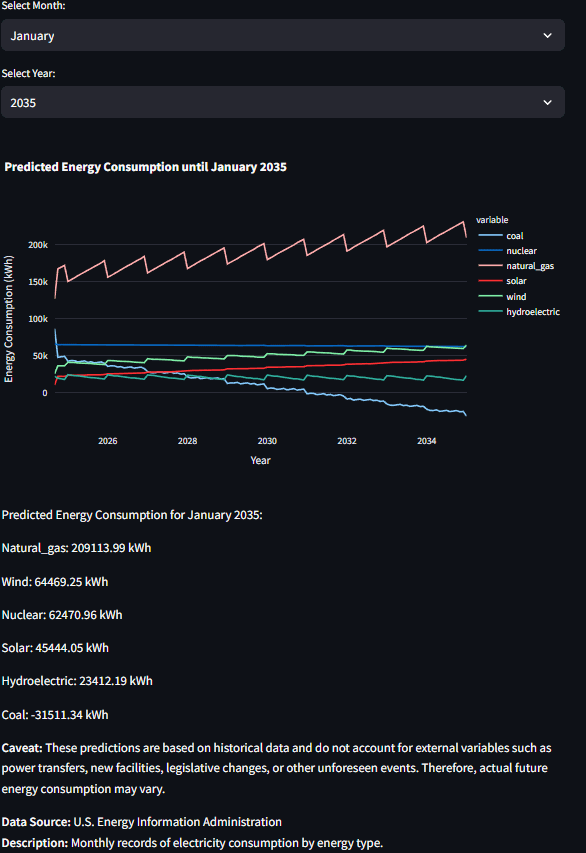
What do you think of my predictive application? It predicts energy consumption by energy type (EIA data). [OC]
Posted by SignalCaptain883

What do you think of my predictive application? It predicts energy consumption by energy type (EIA data). [OC]
Posted by SignalCaptain883
6 Comments
Application and data details:
Application: Streamlit
Programming Language: Python
Data source: Energy Information Administration Monthly Consumption records
Visualization library: Plotly
Predictive model: Scikit-learn LinearRegression
I think Nuclear will go up. I know EIA doesn’t show it, but we have the tech for safe Nuclear, we just need the legislation.
How would coal be a large negative number? It seems to me that energy consumption couldn’t go below zero. But maybe I’ve misunderstood something.
If you’re interested in the energy transition, then I would highly recommend the Volts podcast that discusses this. With regards to future energy sources, I wouldn’t necessarily expect a linear increase/decrease from today. Between AI, the inflation reduction act, the new trump admin, and increasing decarbonization, the energy sector is fairly complicated right now and even in the next year linear changes [aren’t expected](https://www.wri.org/insights/clean-energy-progress-united-states).
Hmm. These models look pretty linear, though the learning curves of renewables and energy storage are exponential. Their adoption has gone much faster than anybody expected.
The unanswered question is whether the administration can turn back the clock in the face of substantial economic disadvantages.
Unlike renewables, nuclear seems to be getting more expensive over time. So your prediction of constant production looks plausible.
Can you share some visualizations or key insights from your application?