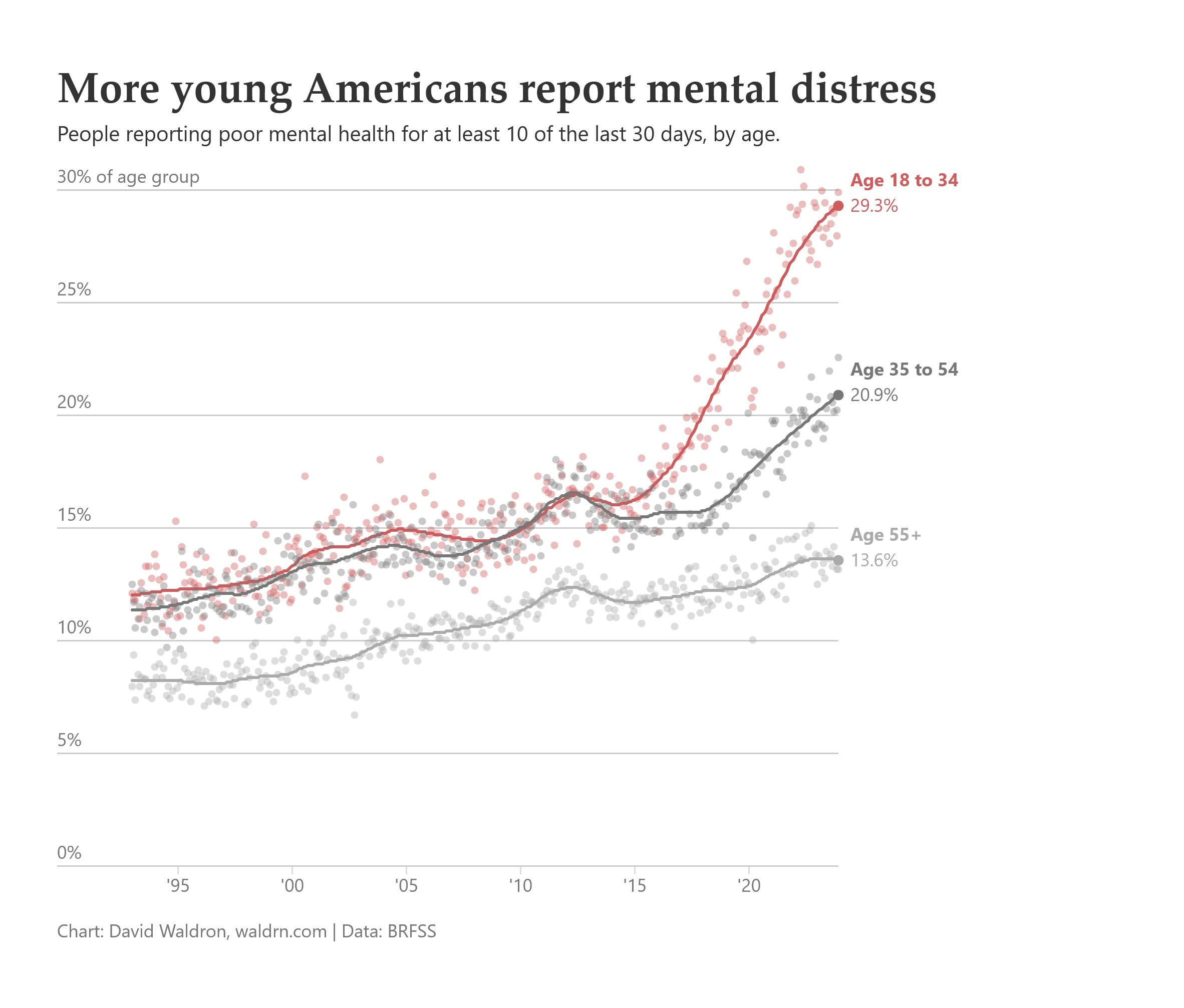
The percent of young adults reporting poor mental health has nearly doubled in the past decade [OC]
Posted by DavidWaldron

![The percent of young adults reporting poor mental health has nearly doubled in the past decade [OC]](https://www.byteseu.com/wp-content/uploads/2025/03/u1ragity0gne1-1536x1308.jpeg "The percent of young adults reporting poor mental health has nearly doubled in the past decade [OC]")
The percent of young adults reporting poor mental health has nearly doubled in the past decade [OC]
Posted by DavidWaldron
17 Comments
Data: [BRFSS from the CDC](https://www.cdc.gov/brfss/annual_data/annual_data.htm)
Tools: R and d3.js
We can kinda tell that Americans aren’t well.
Ladies and Gentlemen, may I present?
Social Media!
Social media will be blamed, and it definitely plays a role, but let’s not forget their (lack of) future.
These boomers would be feeling pretty low if they couldn’t afford a house, or kids, or vacations too.
My guess is mental health treatment continues to be destigmatized, so more people are openly reporting. But also social and political instability, economic hardships and uncertainty, isolation endemic to our social media driven culture, and the trauma of COVID lingering.
As a millennial I totally understand the younger ones being more stressed.
Life got progressively worse as I grew older.
And no, it’s not that I got to see it through a different lens: people my age was considerably happier when I was young.
They bought houses, they believed their carrier was going to get better and better, they formed families like it was just standard and easy, etc.
Life was simply better.
Now they totally destroyed what you Americans call the American dream but globally. People are more “connected” and more alone than ever. Purchasing was replaced by renting. Careers don’t mean shit and you could be dropped off of a job in a hot minute. The idea of a family was demonized and a lot of people avoid it.
Shit is grim.
Unfortunately I think my generation already gave up, but younger ones should rebel. And I don’t mean painting some cars or some other capricious and pointless thing, I mean really criticizing the system in place.
I think this can also be partly explained by the fact that older generations still don’t like talking about mental health issues. Just the word depression still feels like a taboo word to say by some of my older family members.
It’s not my fault my brain is wired this way. I was raised happily, had hobbies, had friends, had a good job, had friends, had a partner, stayed clean, went outside, ate well, and I still had depression. I talk about it because I’m not afraid if it anymore.
I’m always reminded of an older person I once knew poo-poohing therapy by saying something to the effect of “I feel suicidal all the time and you don’t hear me complaining about it!” Older people just don’t admit to needing help because of the stigma drilled into them.
Wow around the time the smartphone becomes populair oure mental heath is going down.
Look at all the people seeing their opportunities and dreams fall through their fingers. All the houses and kids they thought they’d be having. And that’s the age it should all be falling into place.
Of course the older generations aren’t as affected as they got theirs.
This is exactly correlated with the stock market, as the latest bubble started in 2016. So, as the stock market goes up, young people feel like shite because the economy isn’t working for them. Older people don’t really feel the impact, because their lives exist outside the Internet, they have stable jobs, homes, and savings — all the things that young people don’t have and that are actively being taken away from them by the poor perfromance of the starter-levels of the economy. Capitalism sucks and creates many unhappy people. We have all the kitchen-aids and flushing toilets and cheap bacon that we’d ever need, but we’re unhappier than most generations before us (apart from the other generations in the middle of economic calamities, like the Great Depression and the World Wars).
My guess this has a lot to do with what is considered a normal or acceptable amount of stress and fatigue.
Older generations understand the bar of acceptable to be much higher
Boomers believe they own everything and will live forever. Might be true. Damn it.
So the solution is not to be a young American? seems easy enough
Part of it is society becoming more complicated and fraught. Common culture has broken down in the era of choice and niche culture. Individuality increases, but so does loneliness. 80% of people knew who Michael Jackson was back in the day. Now everyone has a favorite band like King Gizzard and the Lizard Wizard. 20 TV channels vs hundreds. Unified culture vs a fragmented one where all the people who share it are online, and you only share that small part.
Part of it is people who want a diagnosis for attention and an excuse for not working on themselves. The type of person who labels themselves “neurodivergent” and says, “Sorry I was a completely unacceptable asshole, but you know, I am -insert condition-” and just brush it off without a second thought.
Part of it is people addicted to the news and doomscrolling and having a hard time compartmentalizing their life. The news will be depressing most of the time, and being unable to escape it will cause someone to spiral. Right now, the They Live sunglasses would show the news broadcaster with a big “You and Everything is Fucked” behind them.
Personally, as far as the news goes, I just don’t think about the world when I am working or engaged with literally any task even as mundane as watching TV. A big one is with my wife, we talk politics like once every six months to angrily agree and then we don’t talk about it because it gets stale fast if we keep bringing it up. It’s a good pressure release.
My mental health takes hits mostly from grappling with mortality and my impotence in this world. Still, I make due. Family and friends are crucial. Drugs are awesome. Most things are going alright in my world. Even though that could change at any moment, but why worry about infinite potential problems before there is an actual problem?
People see these graphs and they misinterpret them on a fundamental misunderstanding
Seeing that part of life is shit and being down about that is not a mental illness, it never was and never should be. Having a maladaptive response to the negative parts of reality is a path to mental illness.
That maladaption can take many forms but many of them are very much enabled by social media and the echo chambers we place ourselves in. If guns and knives are technological enablers of high murder rates then social media is a technological enabler of high rates of mental health distress.
Also we should look at this at a finer grain level – for example at the fact while there is an increase across the board there is a vastly stronger increase among girls and especially among girls with liberal political opinions. We need to look at the particular echo chambers that people are inhabiting and consider that some of those are unhealthier places to be than others.
[https://pmc.ncbi.nlm.nih.gov/articles/PMC8713953/](https://pmc.ncbi.nlm.nih.gov/articles/PMC8713953/)