
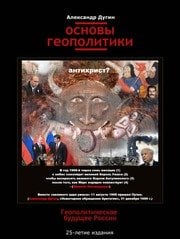
I recently explored Foundations of Geopolitics by Alexander Dugin, a 1997 text available on archive.org (link here: https://archive.org/details/foundations-of-geopolitics-geopolitical-future-of-russia-alexander-dugin-english/page/21/mode/2up).
Dugin, a prominent Russian geopolitical thinker, has influenced Moscow’s strategic circles – notably, Putin distributed this book to military officers, and it’s been part of the General Staff Academy curriculum since the late ‘90s. It’s a lengthy read, over 600 pages, so I ran it through an AI to extract key points. I’d suggest the same if you’re interested; it’s a time-saver. Here’s what I found noteworthy.
What’s Already Come to Pass:
• UK Isolation: Dugin envisioned Britain detached from Europe (page 214). Brexit aligns with this, amplified by Russian disinformation during the referendum.
• Western Instability: He advocated “geopolitical shocks” to divide the West (page 251). Russian interference in the 2016 US election and support for EU populist movements reflect this.
• Ukraine’s Fate: Securing Ukraine was critical (page 377). Crimea’s annexation in 2014 and the ongoing war since 2022 match his vision.
• Eastern Europe Targeted: Weakening Poland and the Baltics (page 367) shows in persistent cyberattacks and propaganda efforts there.
Future Scenarios from the Book:
• Germany’s Shift: A Russo-German alliance over US ties (page 198). By 2040, Germany might pivot east if NATO weakens.
• France’s Realignment: France leading an anti-Atlantic bloc (page 202). A future drift toward Russia could split Europe further.
• Balkan Instability: Strengthening Serbia to disrupt the region (page 353). This could spark conflicts by mid-century.
• Turkey’s Turn: Turkey joining Eurasia, abandoning NATO (page 236). A post-NATO Turkey might reshape the south.
Trump Factor:With Trump and Musk, skepticist toward NATO – threatening to abandon allies who “don’t pay” – we could see an acceleration toward Dugin’s goals. His reluctance to support Ukraine and potential softening of sanctions might give Russia breathing room, leaving Europe fragmented and vulnerable by the 2030s. But maybe not.. I still think this book is incredibly important to understand what’s going on.
Weaknesses in Dugin’s Vision:The book isn’t flawless. His take on China as a Russian subordinate was way off – they’ve outpaced Moscow. Russia’s economic struggles also question its capacity to sustain this. Plus, Dugin’s influence has waned at times; he lost his Moscow State post in 2014 after criticizing Putin. Still, its military readership keeps it relevant.
I might’ve missed some nuances – it’s a dense work, and I’m no scholar. Apologies for any errors. I’d really value your perspectives: does Trump’s return make Dugin’s Europe more likely, or do flaws in his framework – and Russia’s own limits – derail it? What role might tech like AI or other forces play? Curious to hear your thoughts.
Dugin’s Foundations of Geopolitics (1997): A Look at Europe’s Past and Possible Future
byu/michihustler inFuturology
4 Comments
Just the list of bullet points is ominous, here: [https://en.wikipedia.org/wiki/Foundations_of_Geopolitics#Content](https://en.wikipedia.org/wiki/Foundations_of_Geopolitics#Content)
I’ve been looking for a reasonable translation so I thank you for this (the version available on Amazon is apparently terribly machine-translated).
Now on to Project Russia:
1. *Project Russia* (2005)
2. *Project Russia, The Choice of the Way* (2007)
3. *Project Russia, The Third Millennium* (2009)
4. *Project Russia, The Great Idea* (2010)
the china thing is off, yeah; from how Russia has been giving China little pieces of terrain here and there, it’s possible China is expecting to keep being paid like this as Russia keeps the war going; Russia has a bunch of land that was historically’s China so it would not be surprising if they want them back
now, this won’t come as a surprise to Putin, who is the one giving the little land to China right now; he probably suspects that if Russia falls, China may pounce on the opportunity
I think the other hard problem is that attacking Ukraine is on the verge of creating a stronger european coalition, that may even survive USA exiting NATO
both points make me think that, the smartest move right now would be to cash in, broker for peace while trying to keep as much of Ukraine as possible, and prepare for a next iteration
I read parts of this, as well. I found a Russian original somewhere in the depths of the web. I think that the anti-Atlantic bloc (as Dugin describes it) might end up being a mostly autonomous European Union that might drift towards China with time, rather than Russia. As it was written 1997, Dugin was working with how the world was looking like at the time. China is obviously much more powerful than it was in 1997. I think a European alignment with Russia is unlikely for the time being.
Also Turkey appears interested in joining EU efforts, which would go against Dugin’s prediction/wish of them leaving NATO (although they might do this, this move might not necessarily entail moving away from the EU diplomatically).
I think things are not working out the way Dugin had envisioned, but who knows what is to come.
Historically speaking, I don’t think the Turks have much interest in pivoting towards Russia. There is a looooong history of antagonism between them.