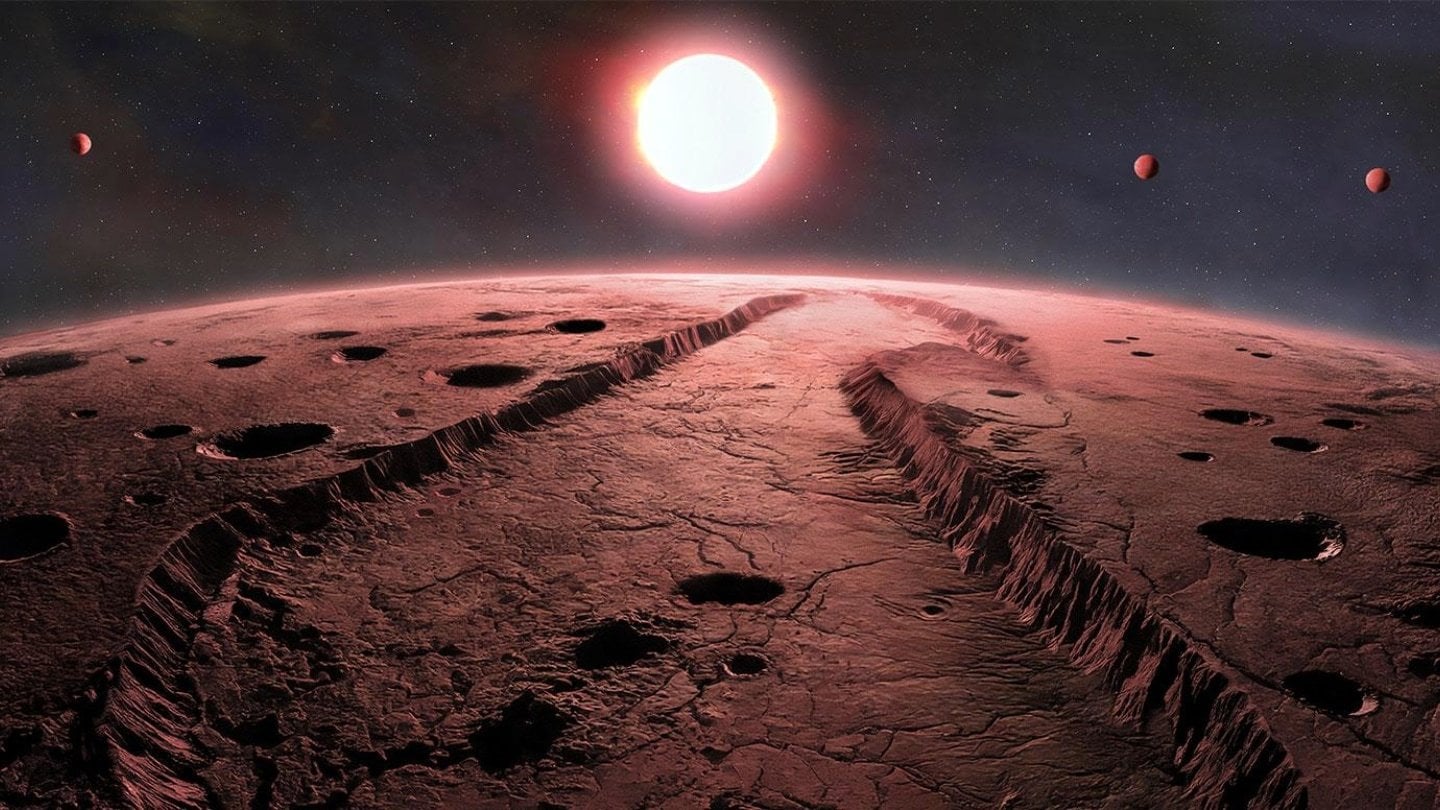
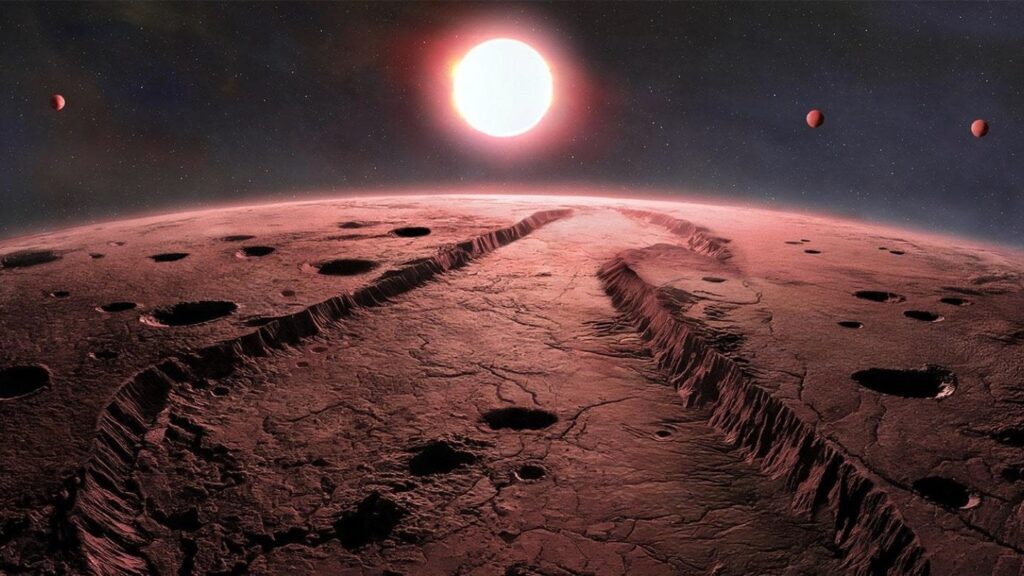
>The nearest single star to the sun, Barnard’s star, has a brood of planets all its own. The red dwarf star, about six light-years from Earth, hosts [four close-in planets](https://iopscience.iop.org/article/10.3847/2041-8213/adb8d5) each about two to three times the mass of Mars, astronomers report in the March 20 *Astrophysical Journal Letters*.
>“Barnard’s star has a long history of claimed detections, but none of them could be confirmed for a long time,” says astronomer Ritvik Basant of the University of Chicago. “It’s pretty exciting to know what’s orbiting the nearest stars.”
>From 2021 to 2023, Basant and his colleagues observed Barnard’s star 112 times using the [MAROON-X](https://www.gemini.edu/instrumentation/maroon-x) spectrograph on the Gemini North telescope in Hawaii. “I was starting to see these signals in the dataset,” Basant says. But because he was still calibrating the instrument, “we ignored it for that time.”
>Then last October, a team using the ESPRESSO spectrograph on a telescope in Chile reported evidence of [one planet orbiting Barnard’s star](https://www.sciencenews.org/article/barnards-star-exoplanet-in-orbit), dubbed simply b, and hints of three others — designated c, d and e. With these hints in mind, Basant and colleagues reexamined their data, confirming three of the planets.
It’s got an itsy bitsy teeny weeny fast orbiting planetary system, all 4 of them hugging the star in nearly perfect circular orbits, going around in a matter of days. Imagine standing on one of them and seeing these other worlds whip pass you, there motion almost certainly noticeable to simple naked eye observation. So many stars have planets – this is a change of awareness that is happened over a few decades, so now we must count the number of planets in our galaxy as likely in the hundreds of billions. How many of them are like earth? Surely, the answer to that must be greater than zero.
bluegrassgazer on
My question is always, “Are any of the exoplanets in their star’s habitable zone?” Alas, not this time:
>All four planets are so close to Barnard’s star, which has about one-seventh the mass of the sun, that they orbit it in less than a week. That means they’re too hot to be habitable, Basant says. In fact, the new observations probably rule out the presence of any habitable-zone planets.
miemcc on
So, there is no double plant with a shared ocean… damn!

4 Comments
>The nearest single star to the sun, Barnard’s star, has a brood of planets all its own. The red dwarf star, about six light-years from Earth, hosts [four close-in planets](https://iopscience.iop.org/article/10.3847/2041-8213/adb8d5) each about two to three times the mass of Mars, astronomers report in the March 20 *Astrophysical Journal Letters*.
>“Barnard’s star has a long history of claimed detections, but none of them could be confirmed for a long time,” says astronomer Ritvik Basant of the University of Chicago. “It’s pretty exciting to know what’s orbiting the nearest stars.”
>From 2021 to 2023, Basant and his colleagues observed Barnard’s star 112 times using the [MAROON-X](https://www.gemini.edu/instrumentation/maroon-x) spectrograph on the Gemini North telescope in Hawaii. “I was starting to see these signals in the dataset,” Basant says. But because he was still calibrating the instrument, “we ignored it for that time.”
>Then last October, a team using the ESPRESSO spectrograph on a telescope in Chile reported evidence of [one planet orbiting Barnard’s star](https://www.sciencenews.org/article/barnards-star-exoplanet-in-orbit), dubbed simply b, and hints of three others — designated c, d and e. With these hints in mind, Basant and colleagues reexamined their data, confirming three of the planets.
Read [more here](https://www.sciencenews.org/article/barnards-star-four-small-planets) and the [research article here](https://iopscience.iop.org/article/10.3847/2041-8213/adb8d5).
It’s got an itsy bitsy teeny weeny fast orbiting planetary system, all 4 of them hugging the star in nearly perfect circular orbits, going around in a matter of days. Imagine standing on one of them and seeing these other worlds whip pass you, there motion almost certainly noticeable to simple naked eye observation. So many stars have planets – this is a change of awareness that is happened over a few decades, so now we must count the number of planets in our galaxy as likely in the hundreds of billions. How many of them are like earth? Surely, the answer to that must be greater than zero.
My question is always, “Are any of the exoplanets in their star’s habitable zone?” Alas, not this time:
>All four planets are so close to Barnard’s star, which has about one-seventh the mass of the sun, that they orbit it in less than a week. That means they’re too hot to be habitable, Basant says. In fact, the new observations probably rule out the presence of any habitable-zone planets.
So, there is no double plant with a shared ocean… damn!
Ref: Robert L Forwards Rocheworld series.