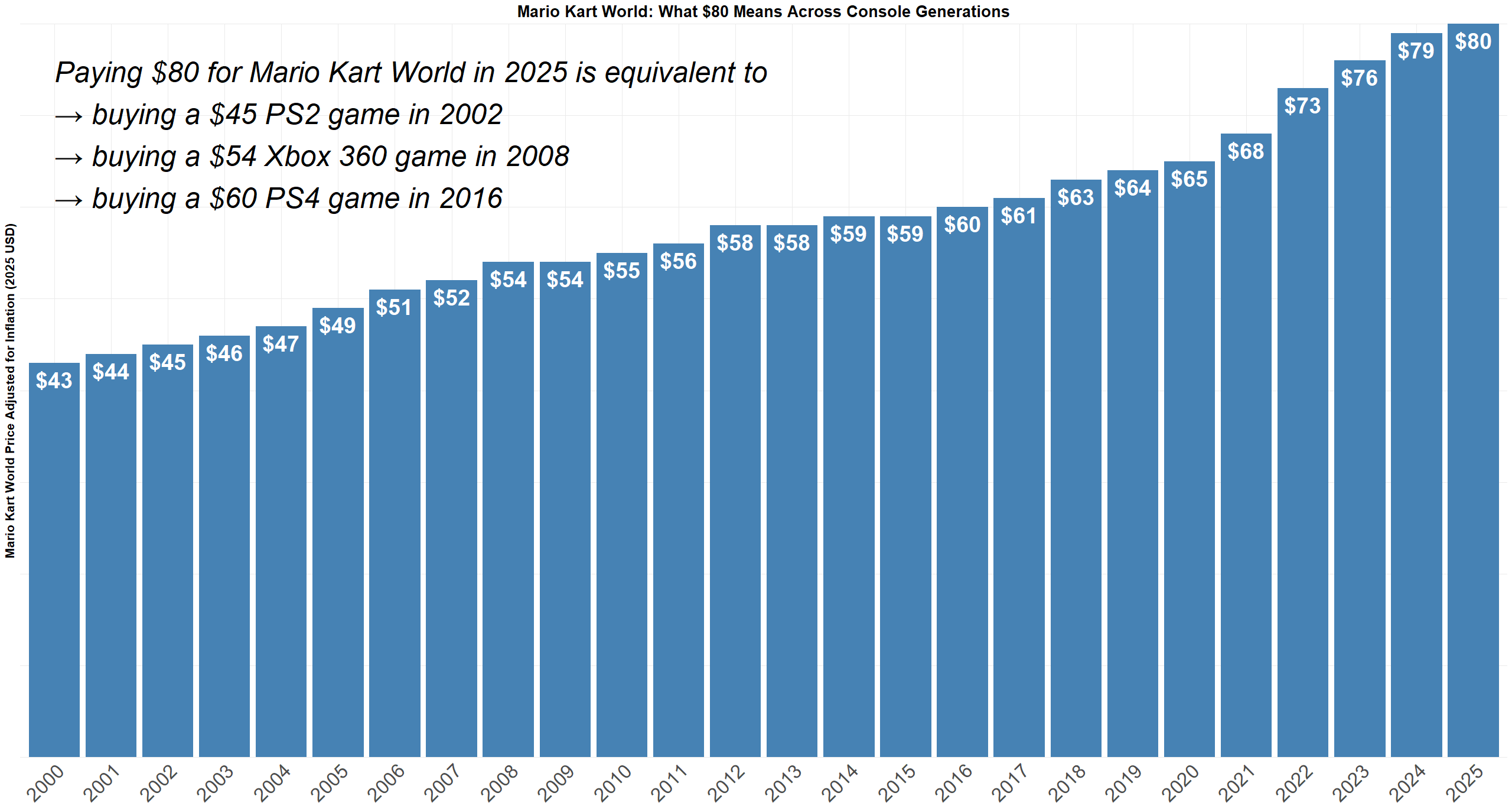
Source: The price of the game was just publicly announced and I simply ran the price of $79.99 through this inflation adjustment tool: [https://www.usinflationcalculator.com/](https://www.usinflationcalculator.com/)
The visualization was done in R with ggplot2.
Mettelor on
Calling them “equivalent” when using a standard inflation calculator is a bit too strong in my opinion, but neat visualization nonetheless.
I imagine they use CPI, or whatever, in that calculator. Why should we think that video game prices inflate at the same rate as a basket of bread/eggs/gasoline/etc?
We shouldn’t, and so “equivalent” for me is a bit too strong.
E: since so many people want to lecture me – I teach econ at a unviersity, I know what I am talking about.
akamonkey48 on
Well seeing how easily games are distributed over digital media, i dont think $80 games are justified.
scottrycroft on
This is just showing that inflation nearly doubled in 25 years, so it doesn’t show any meaning for consoles specifically.
I’ve seen it elsewhere, but tracking the top end AAA gaming price, adjusted for inflation, shows much more meaning.
Lindvaettr on
What I am hopeful for is that the rise of $80 games will encourage more focus on AA games rather than the currently split of mostly single A indie games and huge AAA behemoths. Back in the PS2 and even a bit in the PS3 era, we had a lot of games that were still quite large productions but were not the gigantic ones you see today. Anymore it seems like you either have a small studio making a relatively small game and charging $30-$40, or an enormous studio with 500 devs spending 8 years making a game that costs a billion dollars to make.
What we really need are games that are made by relatively large and experienced teams that they make in 3 years or so for a few 10s of millions and then sell for $50.
Orwell1971 on
When games started to be $70 a couple of years ago, I made this type of argument. It was more of a surprise that videogames had been resistant to inflation for so long than that they were going up at the time. But another $10 increase only 2-3 years later is a horse of a different color, so to speak.
--Arete on
Have you factored in inflation and increased salary?
Malvania on
This is how I find out about Mario Kart World…
apocalypticboredom on
It’d be more interesting to see this contrasted with real wages over the same period.
Farren246 on
Ah inflation. Costs keeps going up, but wages stay the same!
Picolete on
I could understand a third party developer charging more this year as Nintendo gets a %30 cut off their sales.
lostcauz707 on
The key that is often ignored is distribution costs and audience size unfortunately. Once you can download 100gb in an hour or less to millions of consumers, there is an insane cut cost.
GhettoSauce on
Almost 30 years ago, a new copy of FF7 on PS1 was $80, just like the other “big titles” like Metal Gear Solid while games like Twisted Metal 3 was $60. The “Greatest Hits” collection or lesser-known/not as good games were $30. I clearly remember all this because I’d cut out the games and prices from flyers to make a collage of a Christmas list. So when people complain about the same exact prices now, I get confused. Help me out here; shouldn’t the prices of games have skyrocketed over time? I’ve been buying them with my own money for decades and they seem to be the only thing somehow unaffected by inflation.
vgamedude on
Meanwhile I get a download in which data and hosting costs have gone way down vs a physical disc that has to be transported and created. Nah bro
Razorwyre on
Gather around kiddies and let me tell you a story of how I purchased SNES games for 79.99 in the mid 90s. Think Final Fantasy 3 and Chrono Trigger. This isn’t bad at all.
wizardjeans on
It is also interesting how much more we pay for hardware compared to the games we play. I am pretty sure Nintendo, Playstations and Xbox are subsidized by higher game license costs. Graphics card cost went up 50% the past 3 years if you compare 3080 to 5080.
But if you truly value playing high quality games, then you shouldn’t mind paying more. It is not certain that higher cost games are higher quality, but it definitely helps.
LordSlickRick on
Bigger problem is my salary today isn’t equivalent to a 2000 salary. Rents are racing faster than income.

![[OC] Mario Kart World: What $80 Means Across Console Generations](https://www.byteseu.com/wp-content/uploads/2025/04/vraeic2yagse1-1536x821.png "[OC] Mario Kart World: What $80 Means Across Console Generations")
18 Comments
[removed]
Source: The price of the game was just publicly announced and I simply ran the price of $79.99 through this inflation adjustment tool: [https://www.usinflationcalculator.com/](https://www.usinflationcalculator.com/)
The visualization was done in R with ggplot2.
Calling them “equivalent” when using a standard inflation calculator is a bit too strong in my opinion, but neat visualization nonetheless.
I imagine they use CPI, or whatever, in that calculator. Why should we think that video game prices inflate at the same rate as a basket of bread/eggs/gasoline/etc?
We shouldn’t, and so “equivalent” for me is a bit too strong.
E: since so many people want to lecture me – I teach econ at a unviersity, I know what I am talking about.
Well seeing how easily games are distributed over digital media, i dont think $80 games are justified.
This is just showing that inflation nearly doubled in 25 years, so it doesn’t show any meaning for consoles specifically.
I’ve seen it elsewhere, but tracking the top end AAA gaming price, adjusted for inflation, shows much more meaning.
What I am hopeful for is that the rise of $80 games will encourage more focus on AA games rather than the currently split of mostly single A indie games and huge AAA behemoths. Back in the PS2 and even a bit in the PS3 era, we had a lot of games that were still quite large productions but were not the gigantic ones you see today. Anymore it seems like you either have a small studio making a relatively small game and charging $30-$40, or an enormous studio with 500 devs spending 8 years making a game that costs a billion dollars to make.
What we really need are games that are made by relatively large and experienced teams that they make in 3 years or so for a few 10s of millions and then sell for $50.
When games started to be $70 a couple of years ago, I made this type of argument. It was more of a surprise that videogames had been resistant to inflation for so long than that they were going up at the time. But another $10 increase only 2-3 years later is a horse of a different color, so to speak.
Have you factored in inflation and increased salary?
This is how I find out about Mario Kart World…
It’d be more interesting to see this contrasted with real wages over the same period.
Ah inflation. Costs keeps going up, but wages stay the same!
I could understand a third party developer charging more this year as Nintendo gets a %30 cut off their sales.
The key that is often ignored is distribution costs and audience size unfortunately. Once you can download 100gb in an hour or less to millions of consumers, there is an insane cut cost.
Almost 30 years ago, a new copy of FF7 on PS1 was $80, just like the other “big titles” like Metal Gear Solid while games like Twisted Metal 3 was $60. The “Greatest Hits” collection or lesser-known/not as good games were $30. I clearly remember all this because I’d cut out the games and prices from flyers to make a collage of a Christmas list. So when people complain about the same exact prices now, I get confused. Help me out here; shouldn’t the prices of games have skyrocketed over time? I’ve been buying them with my own money for decades and they seem to be the only thing somehow unaffected by inflation.
Meanwhile I get a download in which data and hosting costs have gone way down vs a physical disc that has to be transported and created. Nah bro
Gather around kiddies and let me tell you a story of how I purchased SNES games for 79.99 in the mid 90s. Think Final Fantasy 3 and Chrono Trigger. This isn’t bad at all.
It is also interesting how much more we pay for hardware compared to the games we play. I am pretty sure Nintendo, Playstations and Xbox are subsidized by higher game license costs. Graphics card cost went up 50% the past 3 years if you compare 3080 to 5080.
But if you truly value playing high quality games, then you shouldn’t mind paying more. It is not certain that higher cost games are higher quality, but it definitely helps.
Bigger problem is my salary today isn’t equivalent to a 2000 salary. Rents are racing faster than income.