China’s Nuclear Battery Breakthrough: A 50-Year Power Source That Becomes Copper?
https://peakd.com/hive-114308/@gentleshaid/chinas-nuclear-battery-breakthrough-a-50year-power-source-that-becomes-copper-cbv

China’s Nuclear Battery Breakthrough: A 50-Year Power Source That Becomes Copper?
https://peakd.com/hive-114308/@gentleshaid/chinas-nuclear-battery-breakthrough-a-50year-power-source-that-becomes-copper-cbv
19 Comments
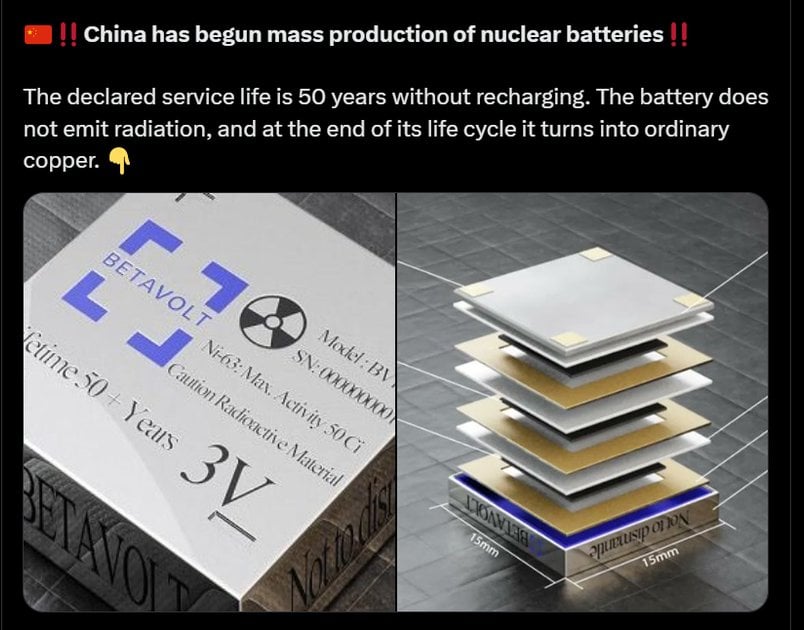
In a world where battery life is a daily headache and recharging gadgets has become routine, a recent claim making waves is nothing short of science fiction turned science fact. *China has reportedly begun mass production of nuclear batteries with a declared lifespan of 50 years, zero need for recharging, no emitted radiation, and a transformation into ordinary copper at the end of its life*. These so-called Betavolt nuclear batteries could be a game-changer for the global energy landscape.
But how real is this? Something for our future?
It’s easy to have a long-lasting battery if it outputs a minuscule amount of power. And this battery outputs a minuscule amount of power. You might be able to light up a LED with the output, and that’s about it.
So I did some quick napkin math. A 2032 Lithium coin battery is designed to provide constant 0.5 mA at 3 volts. If the battery is used constantly it will drain in 20 days. The watts required to provide that level of amperage is 0.0015 W.
You would need 15 of these nuclear batteries to provide the same function of a 2032 Lithium coin battery. Of course they would last 50 years instead of 20 days though.
Edit Off by 10 error fixed.
New microcontrollers could be powered by this, between sleeps. Use a capacitor for higher levels of burst power for Bluetooth…
And the company is dead cause nobody needs to buy battery again for another 50 years. Thus, it is the nature of business or pharmaceutical. There is no money in curing diseases.
100 microwatts x 24 x 365 x 50 = 43.8 watt hours of energy.
It’s impressive for a small battery, but it’s in no way earth shattering.
then why is there a radioactive symbol on the box, and who is going to check it in 50 years ?
They’re safe, if contained. What happens when someone cracks one open, either by accident or on purpose? And could the nuclear material be extracted and collected with nefarious intentions?
Everyone here missing the point. This is how humanity progresses. We can’t just jump from nothing to everything. This is a weak model, but it’s likely taught us a lot. And it will only get better.
Cool propaganda repost…Seen this story a bunch of times over the last year, I live in China…No such batteries to be found (on top of the fact that these produce almost no energy)
Wouldn’t the power output go down over time? I assume less radioactive material > less power.
<10% efficiency ratio on this tech according to Wikipedia skimming. Tech is not new and you’re still producing a very small amount. Like pacemaker sized
Those things that beep randomly to announce people can now run for decades!
Why are people impressed about these batteries we have them already it’s not a new thing
They are going to stack it to 5kw and we get a 50.year car without the need to refuel !
I remember reading an old Scientific American from the 1960s that had an ad for nuclear batteries that lasted decades. So this is very old technology. Ending up with copper is an advance over the old type that produced a mix, some of which were still radioactive.
Betavoltaics have been around since the ’70s this is literally just capturing beta radiation from a decaying nickel isotope
It’s the same idea as a tritium glow scope
These things are currently horrendously expensive and low powered, but that is how all tech starts out. If they can bump up the efficiency and bring down the price significantly, they could make more applications feasible using this tech.
Imagine chaining these together into a block large enough to be an emergency power backup for your house. Then, if every house had one, we could stem the need for more power plants.
Imagine fields of these blocks placed under the fields of solar panels and used as a clean form of power generation. Granted, I don’t know how clean it is to produce these; just the lack of radiation and radioactive material at the end doesn’t mean they’re green or carbon neutral.
and for enough wattage to run your smart phone, you would need about 150,000 of these batteries. Assuming they are a similar weight to a 2032, that’s about 450kgs of batteries, or 992 lbs. Not exactly revolutionary since we’ve had this technology since the midcentury, and the concept was first thought of in 1913.