
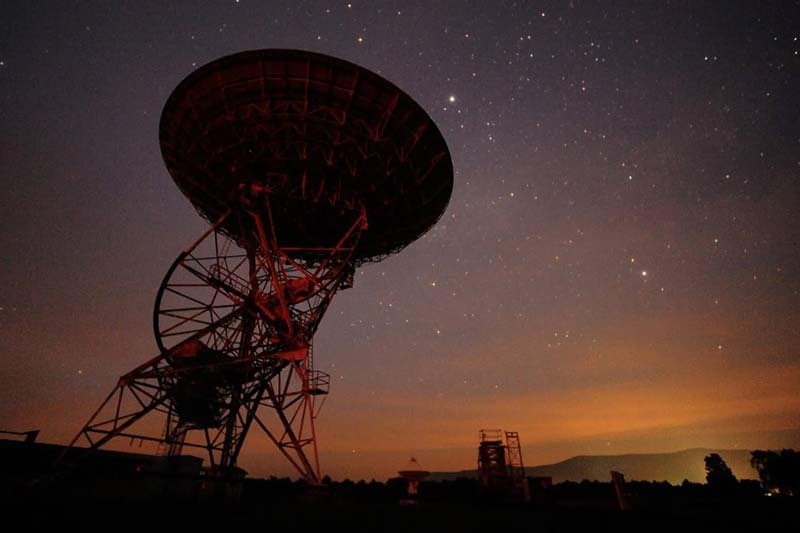
Launched in 1985 with Carl Sagan as its most recognizable champion, SETI was the first major scientific effort to listen for intelligent signals from space. It was inspired by mid-20th century optimism—many believed contact was inevitable.
Now, 40 years later, we still haven’t heard a single voice from the stars.
This article dives into SETI’s philosophical roots, from the ideas of physicist Philip Morrison (a Manhattan Project veteran turned cosmic communicator) to the chance conversations that sparked the original interstellar search. It’s a fascinating mix of science history and existential reflection—because even as the silence continues, we’ve discovered that Earth-like planets and life-building molecules are common across the galaxy.
Is the universe just quiet, or are we not listening the right way?
https://sfg.media/en/a/still-alone-in-the-universe/
45 Comments
Intelligent life it seems, is incredibly rare.
I always think about this (meant to be) funny comment that actually feels more legit than I think the poster meant it to be…we’re the post apocalyptic monsters…the asteroid that wiped out the dinosaurs was the apocalypse. And that led me to really think about how maybe there were plenty of other intelligent alien races out there…100s of millions ago, and now most of em are extinct.
SETI institute was founded in 1985, but the search had begun in 1960’s. NASA funded it for decades. Here’s a full [timeline](http://www.setileague.org/general/history.htm).
Early searches were focused on nearby stars, and every decade their technology for detection and analysis increases by orders of magnitude. SETI can monitor and analyze a much broader spectrum across a larger swath of sky than ever before.
Have we examined that much in sufficient detail to be sure? Should we be expecting that many alien civilisations at the right distance to be noticed right now? Is 40 years really that long in context?
“Space is big. You just won’t believe how vastly, hugely, mind-bogglingly big it is. I mean, you may think its a long way down the road to the chemist’s but that’s just peanuts to space.” – Douglas Adams
It’s very big and very old. Intelligent species currently alive could be trillions and we might still not know.
It took billions of years for spacefaring life to evolve on Earth. We could be surrounded by life sustaining planets, but never detect them because they’re a few million years behind. Humans have been around for an incredibly small part of Earth’s history.
[The answer, in one image](https://planetary.s3.amazonaws.com/web/assets/pictures/_2400x2400_crop_center-center_82_line/20130115_radio_broadcasts.jpg.webp)
To see or hear what we’re looking for, it would have to have been sent directly toward us with enormous power, or broadcast in all directions with *staggering* power, thousands or millions of years ago, or would have to be truly enormous in scope, e.g., a Dyson swarm, to effectively modulate the light of a star on the same scale.
They’re checking signals that can only travel at the speed of light. So 40 years of checking gets us a 40 light year radius around Earth. There’s not many stars in that area, and fewer that might have inhabitable planets. Until we figure out other ways of communication that reaches out further, then we won’t find much with a radio. Then there’s the question of time. If we find proof of life, but from emissions that are millions of years, then is life still out there?
We need to do more with the hypothetical.
I was always told that our radio transmissions from our own planet basically become indistinguishable from background noise after about 100 to 200 light years. So we could very well be getting blasted by alien radio messages from millennia past but we would have no idea.
If that is true then it’s no surprise SETI hasn’t found anything.
Space is *really* big, our technology isn’t great, and signals attenuate with distance.
If there was an identical Earth just like ours in the star system nearest to ours, which is around 4.6 LY away, we would not be able to detect it with our current technology.
At most we’d have some odd atmospheric chemistry that we *might* be able to detect if the planet and star was aligned exactly right, but that’s about it.
Even just our own galaxy is absurdly large, and our surveys so far are the equivalent of taking a bucket of sea water and declaring there are no fish, whales, or seals in the ocean.
Hell, we can’t even tell if there is life on other bodies *in our own solar systems*. It’s no surprise at all that even if there is other life in the galaxy we haven’t been able to detect it.
And 40 years is a *tiny* amount of time. We wait longer than that right here on Earth to see certain plants flower so we can properly identify them.
Basically, everyone is way, way too impatient and most folks have no idea at all of the scales involved.
Because SETI is looking at the radio spectrum. Any extraterrestrial life intelligent and technologically proficient enough to attempt to communicate would like laser light for long range communication.
“Begging your pardon sir, but its a big ass sky!”
40 years is nothing at all, really nothing at all, maybe even less.
Radio astronomer here! I actually did a summer internship many years ago as a student at the SETI Institute, working for [Jill Tarter](https://en.wikipedia.org/wiki/Jill_Tarter) herself, as my first taste in radio astronomy research. And one of the big lessons for me when I became a professional radio astronomer myself is just how *hard* radio astronomy is, due to the lack of signal strength and size of telescopes. It truly doesn’t surprise me that we haven’t heard anything from aliens yet via radio signals, even if there’s thousands of others in our galaxy using this kind of tech.
The big one to realize is in space, light travels via an [inverse square law](https://en.wikipedia.org/wiki/Inverse-square_law), and *wow* is it a killer. We would have a tough time detecting our strongest signals even at Alpha Centauri, our closest star! [This What If?](https://what-if.xkcd.com/47/) goes into great detail about this. We don’t ultimately spray much signal into space that’s detectable either despite what people assume- it’s pretty wasteful in terms of power so an unneeded expense- so presumably others would do similar.
So ok, let’s say the aliens really want to chat so they have a powerful beam, well beyond our current tech. They’ve got a lot of confirmed exoplanets to target, so can only do a short period for a short time. So, they point it at us today, at a level we could conceivably detect… *but the telescope is not pointed in that direction!* Like y’all, do you realize how *big* the sky is? So big you could fit over 60,000 full moons in it size-wise, north and southern hemispheres. If you had a telescope with a field of view the size of the full moon, that’s a HUGE field of view! So it’s not at all surprising that you might just miss the call when it happens.
Seriously, I can’t tell you how often we are interested in a patch of sky in radio and turns out no one has observed it before, except some shallow sky survey that was looking there for 10-20min a couple years ago if you’re lucky. It’s a BIG sky!
So yeah in conclusion, I have great respect for those who do SETI. I don’t personally have the patience for it, but I do very much think “it’s really fucking hard” is the most likely answer over whatever Reddit thinks.
SETI is like me when i’m searching for my keys while holding them in my hand.
If I were watching the last 40 years from up there, I wouldn’t contact us either. Seems like an invitation to a lot of crazy nonsense.
Why would any advanced civilization use the limited capabilities of rf transmission when there are more capable technologies that we don’t understand. Seti is like a tin can on a string.
Why would any advanced civilization use the limited capabilities of rf transmission when there are more capable technologies that we don’t understand. Seti is like a tin can on a string.
I think it’s likely that an advanced technological race would have less technosignature than even we would, as if you think about it as capability increases, the less energy is wasted and emitted as noise.
The other problem is that seti is primarily looking for fixed narrow band radio emissions that repeat. It may be that for an advanced race, their is really no reason to put any energy into broadcasting radio waves as a communication tool. If you did, it would be a weak signal. You don’t need a big signal broadcast to the rest of the universe if your detectors are significantly advanced!
I would think using space bound x ray observatories or even putting one on the moon would be the best option. Use x rays and visible light to analyze specta for biosignature on different planets may be the best option going forward.
We have been listening for 40 years or 0,000000289855072463% of the time our universe has existed. Yep, strange we didn’t get reached by any signal yet.
Something that boggles mind, is that even if we ever do receive a broadcast that is undeniable proof of other intelligent life, it may have been sent by a species that has been extinct for millions of years.
It is like looking for fish in the ocean using a thimble.
Edit: a microscopic thimble made out of nanofibers that is only vieweable through an electron microscope. (probably not scientifically correct but you get the metaphor. x)
Edit again: i did not spell thimble correctly.
Our universe is “young” if you take into consideration just how much it has left before it finally dies. It’s been existing for “just” 13 billion years, which is fewer than what many stuff in space lives (like black holes for example).
Maybe we are indeed one of the most advanced civilizations in our galaxy right now. I think life is extremely common, and intelligence is common enough, but it’s still too early for the first galaxy-spanning civilization to occur.
I think people wildly overestimate how visible even a powerful interstellar civilisation might be.
Ignoring exotic stuff like Warp-trails or huge energy-signatures or thermal blooms (all of which is likely to be science-fiction territory)
We look for stuff like Dyson Swarms or similar, assuming an interstellar civilisation would need that kind of energy-output, or bright radio-flares of civilisations trying to communicate, or just talking loudly.
But then.. why? Imagine our ancestors looking for a bonfire the size of a town because they believe that the heat-needs of a future civilisation would be that big.
Except that we don’t do it with a single huge fire, we have coal/oil/nuclear power plants, and they absolutely do produce the energy output of a city-sized bonfire (or more!) but if you’re not looking for a large building because you’re looking for a bonfire lighting up the horizon, you’re never going to find it.
And that’s assuming they would even need that kind of scale of energy-production.
A civilisation might lean more towards efficiency and choose to spread out more quietly.
Or they might manage their population and never grow to the point where harnessing an entire star is important to them.
There could be (and may well be) advanced civilisations all over the galaxy, but they’re not doing anything that we’d be able to spot from lightyears away.
So that’s the passive-approach out.
What about signals from the stars?
Well.. Our own radio signals will attenuate to be indistinguishable from the cosmic background radiation at around 300 – 500 lightyears, and we’ve gotten more and more efficient with that over time, so realistically newer signals aren’t going to go that far either.
Never mind that those signals *haven’t gone that far yet*.
Radio signals travel at the speed of light.
Our earliest signals haven’t gone more than 100ly away because we sent them within the past century.
That’s a lot of potential stars in that bubble (upwards of 10,000), but in the grand scheme of things it’s absolutely nothing.
The galaxy is 200,000 lightyears across and contains several hundred billion stars.
Our loudest signals won’t make it more than a percent or two of that distance.
Let’s say that alien life is present on say.. 1 in 10,000 of star-systems.
That would mean there’s around 40 million worlds with alien life on, and assuming the same distribution we currently experience, each one would be around 200ly apart.
We *might* be in range to talk to a few of our neighbours, but we’d basically need to be signalling loudly in all directions for 400 years until someone answered.
We haven’t been signalling long enough to get a response, assuming there’s anyone in range to hear.
The universe is big. I mean really big. The time it takes for communication let alone a ship to traverse the distances between stars is enormous. I don’t doubt that there is life out there, but considering that it would take us about 73,000 years to (current technology) to get to Proxima Centauri we just haven’t been around long enough.
If some how we do manage to crack faster than light travel or near light speed travel, relativity would make any discoveries by these crews unfathomable as time would continue to march on for those of us back on earth
1985? Carl Sagan? Frank Drake would like to have a word with you…
Is it a coincidence I just watched Contact yesterday and now I see this thread
It is quite possible that galaxies contain only one or maybe two sentient races at a time given the odds. Now given the time frames, and a potential lifespan of say 1million years and the fact that the milky way is 100K light years across and it would take 100K years for a signal to traverse the galaxy, the likely hood of existing at the same time as other detectable signals and receiving them is likely quite low.
Cause we using tech that is fucking ancient that’s why.
We share this planet, teeming with life, with a variety of different species and we can communicate with none of them.
And we are the only ones leaking radio signals into space, at incredibly low power.
So I’m not surprised.
Well for starters, as “The Animaniacs” sang:
“It’s a great big universe
And we’re all really puny
We’re just tiny little specks
About the size of Mickey Rooney
It’s big and black and inky
And we are small and dinky
It’s a big universe, and we’re not!”
There’s another argument that the universe is still too young to have developed sufficiently intelligent life. I’m not even sure we qualify at the moment.
The universe is extremely large. Much further than your local corner shop. That’s peanuts to space. I read this somewhere and was also advised not to panic.
We can’t even be sure there isn’t a 9th planet in our solar system. We haven’t explored our own oceans. Finding any evidence of life is much more difficult than either of those things.
We don’t see it because its not there except on vastly separated scales.
If it were common the galaxy by evolutionary timescales would be swarming with aliens all wanting their piece of the pie. We would be seeing things such as stars behaving strangely and entire galaxies in the process of changing shape and wild things going on spectrographically all over the place (such as analysing a star and finding metallic signals). This emphatically does not exist. And its only getting worse as our detectors, our telescopes and our techniques improve. Today individual projects looking at billions of stars and galaxies a year have become common place and its all utterly untouched looking.
This is all so achievable for another species that I could rattle through at least 2 schemes to travel to another star in a Human life time that uses strictly current non cutting edge technology. The only thing preventing the immediate infrastructure build up to it right now is refining our rocket technology for the 1st step. There are space agencies already designing solar sail based probes for interstellar missions.
The next generation telescopes that are designed for detailed exoplanet analysis will pretty much be the end of it. The assumption that aliens rarely leave home for whatever reason is pretty much the last hope for common aliens and I think its a very fragile argument.
They’re avoiding us. We have nothing to offer a space fairing species.
Because they could be using different form of comms. Radio, which is around the speed of light, is not meant to be used as comms in light year distances. It is likely an advanced civilization that can contact us have no reason to contact as they’ve already seen everything. The less advanced ones like us will never be able to contact or observe anyone with our current technology.
It also didn’t check a percentage of what we can see yet.
There could be thousands of civilizations like us or even way beyond us but yet none of us will ever discover/find each other do to the vastness of the universe.
In the words of Billy Bob Thornton,
“It’s a big-ass sky”
We seriously underestimate how hard it is to do anything in Space.
To be fair, the people on North Sentinel Island don’t know radio waves exist. Billions of conversations, art and communication stream through their bodies every second of every day and they are none the wiser.
Maybe from a galactic perspective, we are they.
Back when bitcoin was in its infancy, I started mining it and got around 5 coins and stopped. Thought it was stupid, deleted everything and instead did SETI@home for months.
Now my favorite “joke” I like to tell people is; not only am I not rich, but still no aliens.
According to the article, the search goes back to 1959.
Question: is this hypothesis falsifiable, or is it a matter of faith? Scientific questions must be falsifiable, that is, they must be capable of being disproven. Experimenters are given a reasonable period of time to show results; if they can’t then the hypothesis is considered disproven. Is forty-plus years not sufficient?
In the 19th century, natural philosophers searched for evidence of the Biblical flood. They searched for decades. But eventually they admitted that the lack of evidence meant there had been no such universal flood. The Bible was wrong. Will the believers in extraterrestrial intelligent life ever be so broad minded as those Christian natural philosophers?
Is belief in extraterrestrial intelligence science or is it faith?