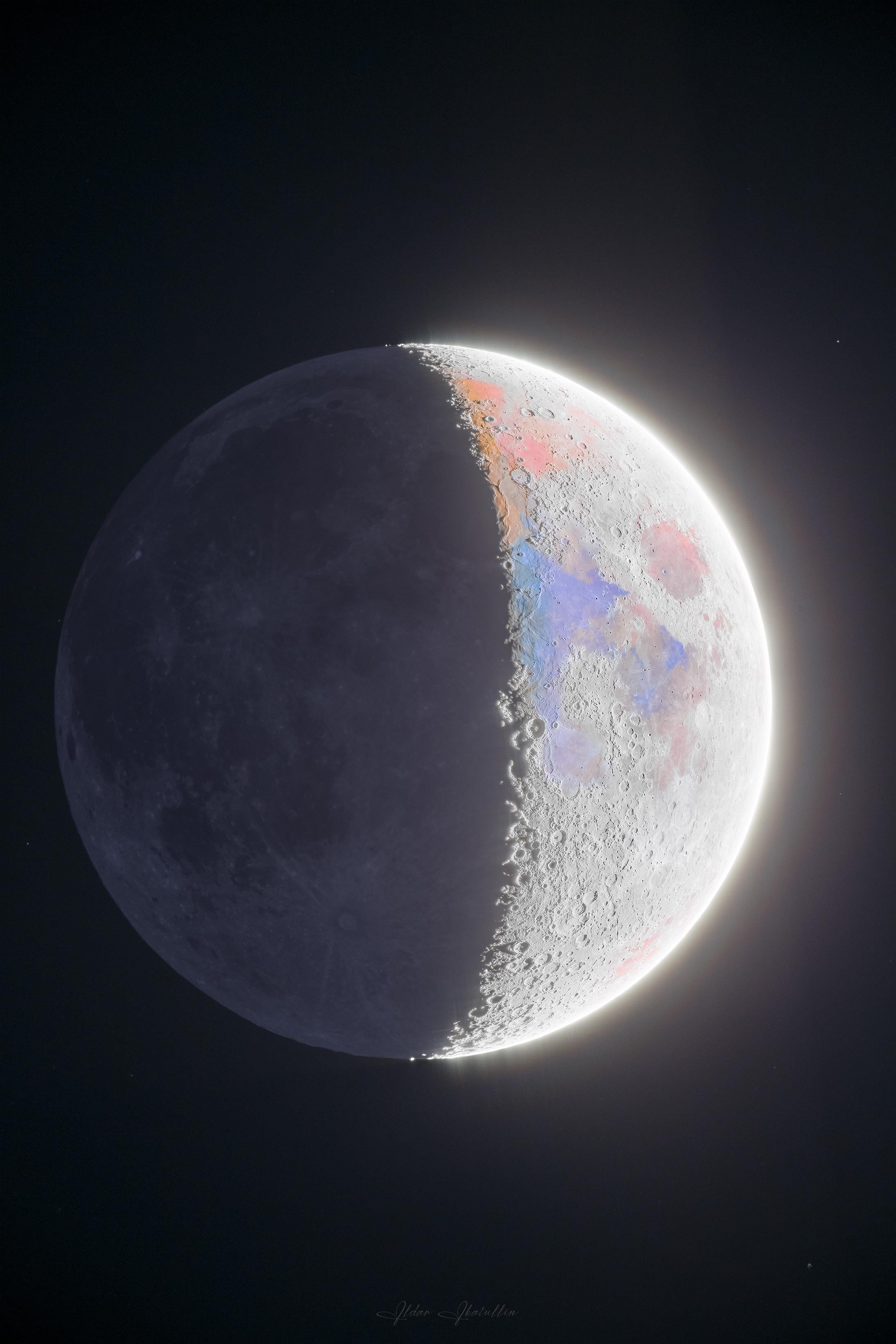
I spent 30 hours processing 500 frames of the Moon to bring out all the fine details.
https://i.redd.it/7ed15y9l5kue1.jpeg

I spent 30 hours processing 500 frames of the Moon to bring out all the fine details.
https://i.redd.it/7ed15y9l5kue1.jpeg
8 Comments
This single image is the result of stacking and editing about 500 frames (20GB of raw data) taken on 3 April 2025! It took me 30 hours of processing to get the details and colors right.
Normally we see the Moon as gray. Here I intentionally exaggerated the saturation of the lunar seas. The red-pink hues indicate iron oxide and the blue hues represent titanium oxide.
In addition, I was able to show the unilluminated side of the Moon with the HDR technique of stitching together few dozen frames at slower shutter speeds.
Notice the various optical phenomena observed on the photo: rainbow around the Moon due to dispersion, diffraction rays due to the construction of Newtonian telescope.
Equipment: I used an Canon 6D amateur camera, a 2x Barlow lens, a GSO 150/750 reflector telescope and an Arsenal EQ5 mount.
You can download the full-resolution image for your wallpaper from my [Flickr](https://www.flickr.com/photos/201107309@N04).
Magnificent! Thanks for sharing your dedication.
OP you can’t post this without marking it nsfw because this is hot you cooked hard with this and it’s so beautiful thank you for making and sharing!
Beautiful pictures. I also checked your Flickr. 😉
I am going to spend 10 seconds writing this and stealing this photo
Can you ELI5 how this works? Are you taking photos of small sections and stitching them together? Are you taking a photo of the whole celestial body at different exposures? I’m a cinematographer so I know cameras, but I never understood how astro-photography uses hundreds of photos to produce an image like this.
20gb of data 😅 here I am stressing out about a gimp project that is exceeds 1gb..
Amazing result OP, so detailed and interesting.
WOW. I think this is the clearest shot of the moon I’ve ever seen. Fantastic work!