
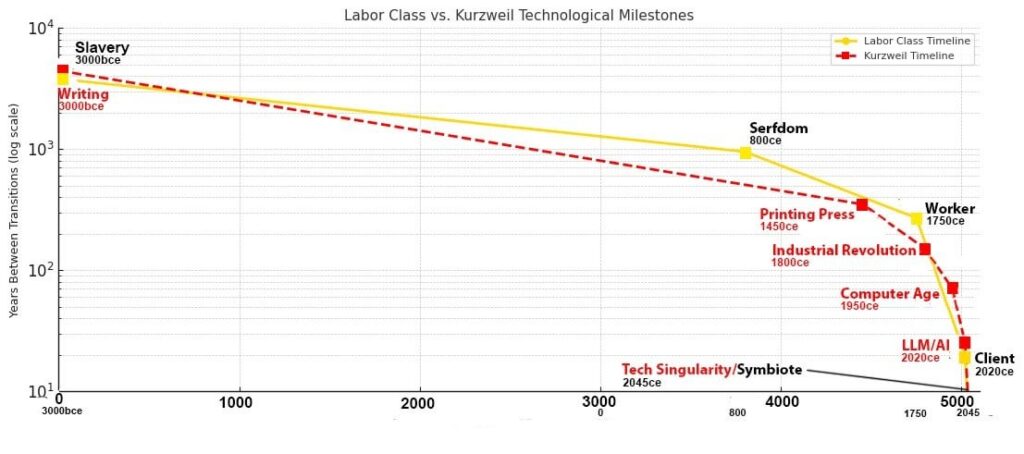
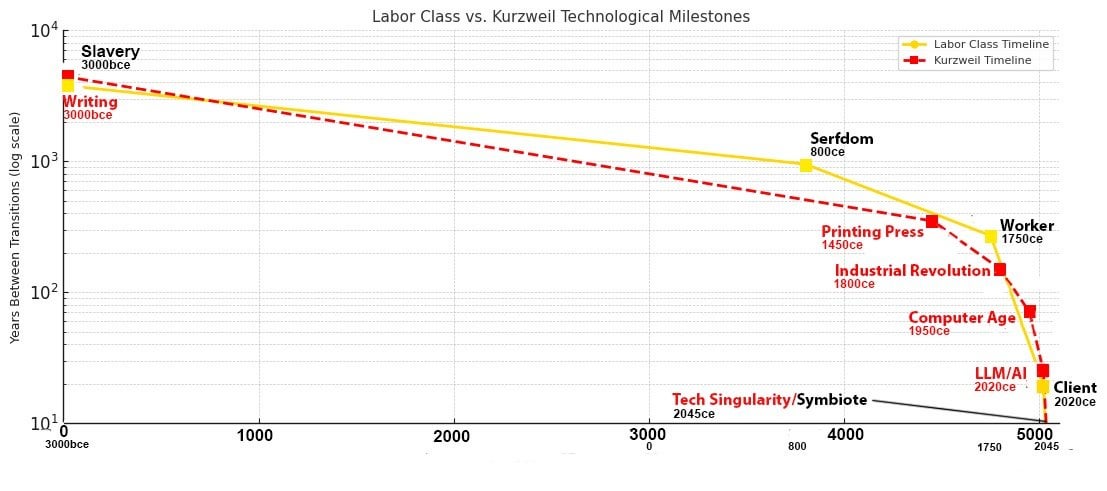
I wanted to see if historical labor class transitions (slave, serf, worker, etc.) followed a predictable pattern—specifically, whether they were compressing over time.
Then I overlaid them with Kurzweil’s timeline of major technological milestones.
I didn’t expect them to align as tightly as they did.
Graph: https://imgur.com/a/QQ84zKj
Curious if anyone else has explored this comparison—or sees implications in the way labor and tech seem to converge around 2045.
(Submission Statement in first comment)
Labor Class Shifts and Kurzweil’s Singularity Timeline Graphed Together
byu/yourbutthurtstoo inFuturology
3 Comments
**Submission Statement**:
This graph attempts to visualize whether labor class transitions throughout history (from slavery to potential human-AI symbiosis) follow an exponential pattern similar to the accelerating milestones in Kurzweil’s tech timeline.
It’s meant to raise questions about whether labor, like computation, is converging toward a singularity point—and what that might mean for the future of employment, identity, and agency in a post-work society.
2045, huh? Almost sounds like you’re predicting some kind of dystopian future where we all become slaves to our AI overlords or something. What a neat 1984 way to say we’re screwed if tech keeps taking over, right? I mean, it’s mind-blowing and all to see patterns, but this also seems like a crazy way to say, “Hey, y’all, maybe we’ll end up in some sort of Matrix nightmare by 2045.” I get why people are fascinated by trying to predict the singularity and tech’s impact, but maybe we should focus on how to actually prepare people rather than throwing more timelines at it. Sometimes I feel like all these predictions are just more ways to give up on saving any humanity we got left before tech sprawls even more out of control. Thoughts?
~2045 is also when the club of Rome predicted the collapse of society.
You should read progress without people or forces of production, both by David Noble.