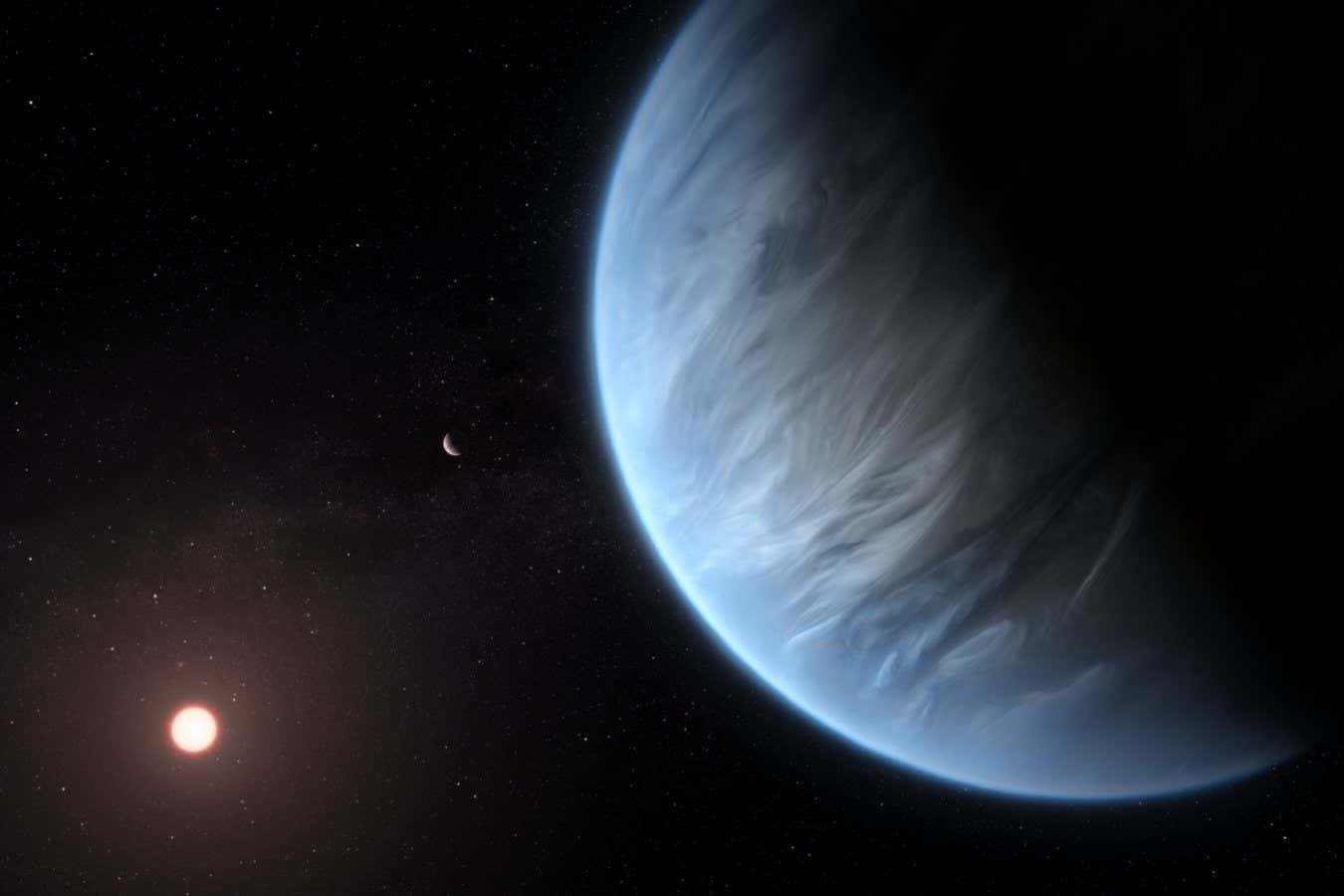
“These are the first hints we are seeing of an alien world that is possibly inhabited”: astronomers claim evidence of life on another planet
https://www.newscientist.com/article/2477008-astronomers-claim-strongest-evidence-of-alien-life-yet/

“These are the first hints we are seeing of an alien world that is possibly inhabited”: astronomers claim evidence of life on another planet
https://www.newscientist.com/article/2477008-astronomers-claim-strongest-evidence-of-alien-life-yet/
13 Comments
Astronomers are urging caution, but if confirmed this would be one of the biggest scientific discoveries of all time, and could fundamentally transform our understanding of life’s prevalence in the universe and accelerate investment in next-generation telescopes and detection methods. The cautious approach by some astronomers stresses the extreme scientific rigour needed when making claims like these. How would confirmation of alien life, even microbial like this might be, reshape our technological priorities, philosophical outlooks, and geopolitical relationships in the years to come?
We need to tariff these aliens immediately they’ve been leeching off us for years. /s
Good thing we’re destroying NASA and wiping science off our list of priorities…
It would be astoundingly — even *laughably* — arrogant for humanity to hold the belief that it *alone* is somehow ‘privileged’ to be located on the **only** planet, in the unimaginably gargantuan expanse of the universe, to be capable of fomenting and maintaining life.
Somebody please TLDR this article for me because i feel like it’s every month we have another “THIS NEW EXOPLANET IS THE BEST CANDIDATE FOR ALIEN LIFE EVAAARRR” article come out and it’s always bullshit
DMS is “highly likely” from intelligent life, but this is far from a concrete confirmation.
Wouldn’t it be grand to put an end to our religions and finally give up on the idea that we are unique in any way.
So the planet smells a bit like cabbage then? (Dimethyl sulfide)
Basically impossible to rule out an abiotic source though, I’d have thought. It’s not a super complex molecule.
Can someone with an astronomy background shit on my optimism here and break down what was actually found?
It will be interesting to learn more, but I highly doubt that this planet has aliens for these reasons:
* The host star is a red dwarf. In order for the planet to be in the THEORETICAL “habitable zone”, it has to be so close that it’s probably tidally locked and subject to solar flares.
* Given the exoplanet’s size, it’s more like a warmer version of Neptune than another Earth. It wouldn’t even be suitable for colonization.
> Other scientists are more sceptical about the findings. “These new JWST observations do not offer convincing evidence that DMS or DMDS are present in K2-18b’s atmosphere,” says Ryan MacDonald at the University of Michigan. “We have a boy-who-cried-wolf situation for K2-18b, where multiple previous three-sigma detections have completely vanished when subject to closer scrutiny. Any claim of life beyond Earth needs to be rigorously checked by other scientists, and unfortunately many previous exciting claims for K2-18b haven’t withstood these independent checks.”
Don’t get too excited.
Its K2-18, its nothing. Likely not even a marginal detection of a molecule thats not actually a biosignature.
Given the distance of the planet, how far back in time is our data that’s hitting the James Webb sensors?