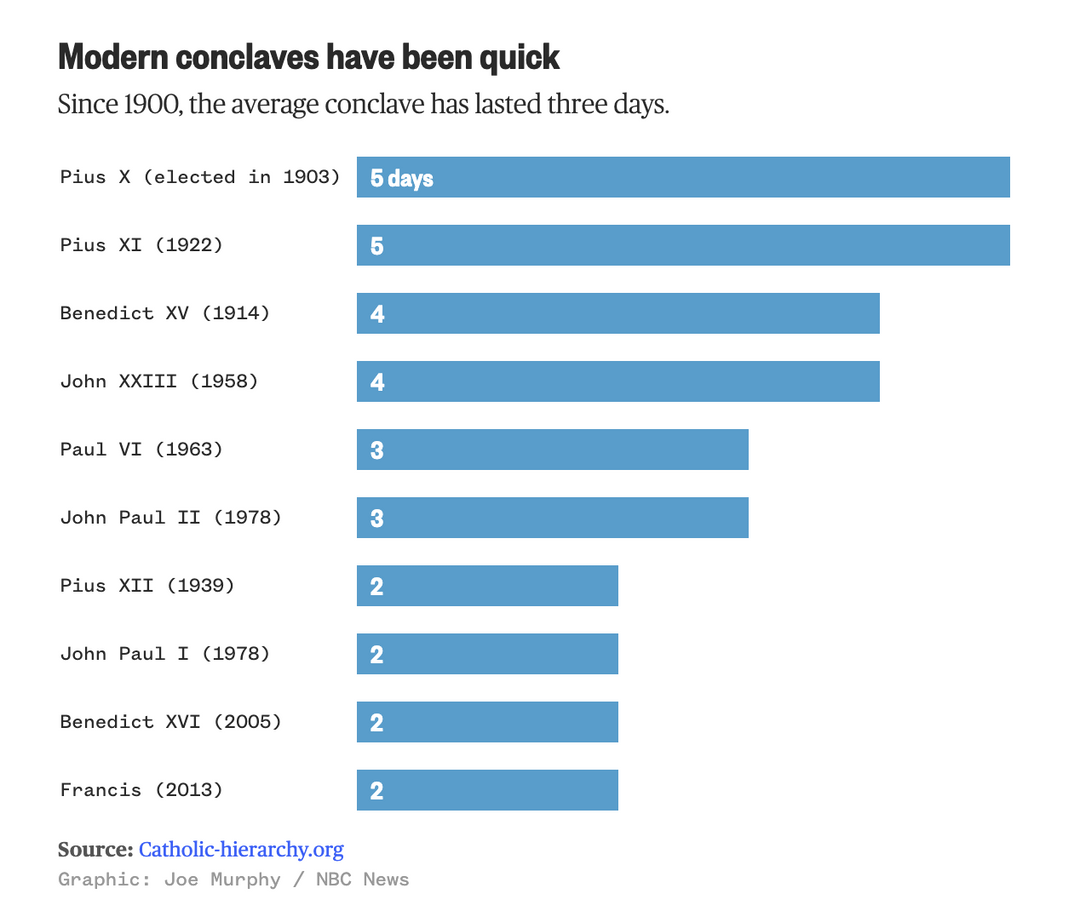
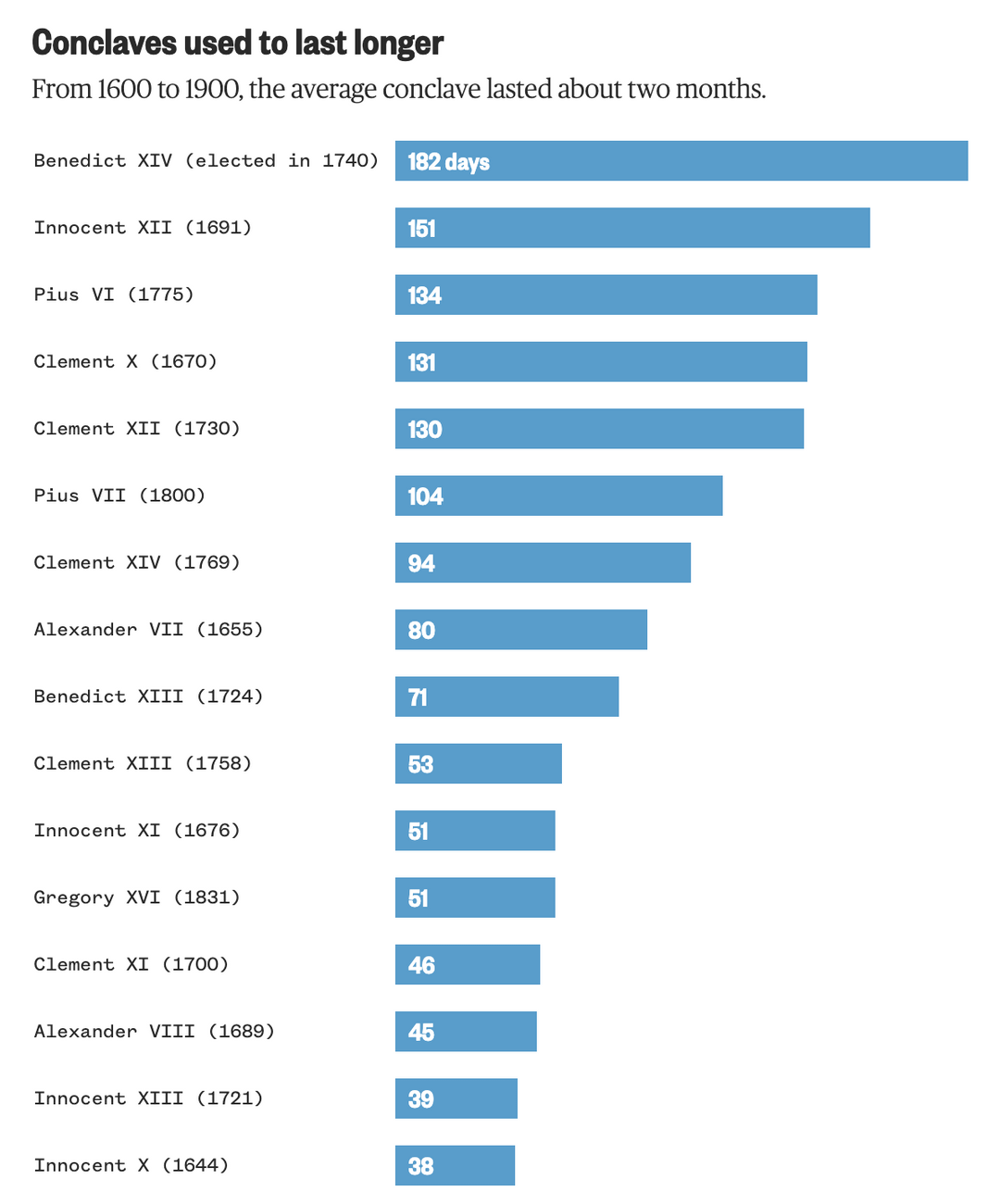
OC: It’s been nearly 200 years since a conclave took longer than a week, with modern conclaves typically taking two to three days.
Posted by nbcnews

OC: It’s been nearly 200 years since a conclave took longer than a week, with modern conclaves typically taking two to three days.
Posted by nbcnews
23 Comments
Catholic cardinals from around the world are converging on Vatican City in advance of [the conclave ](https://www.nbcnews.com/news/world/pope-francis-dead-what-happens-next-rcna128745)that will elect the successor to [Pope Francis, who died Monday](https://www.nbcnews.com/news/world/pope-francis-dies-rcna192559). [Favorites have emerged](https://www.nbcnews.com/news/world/francis-dies-who-will-be-next-pope-rcna103044), and once the conclave begins it likely won’t be long before a new pope is announced, as data shows that conclaves don’t take as long as they used to.
Conclaves were first used to elect a pope [about eight centuries ago](https://www.nbcnews.com/id/wbna7373429), with early elections lasting months, even years.
More here: [https://www.nbcnews.com/data-graphics/pope-how-long-conclave-cardinals-papal-names-oldest-age-charts-rcna201635](https://www.nbcnews.com/data-graphics/pope-how-long-conclave-cardinals-papal-names-oldest-age-charts-rcna201635)
Probably because it was difficult to travel in past and much easier now ?
There’s probably a bunch of Whatsapp chats going about before the conclave, where in the past all the cardinals had to get all the way to the Vatican to begin their campaigning. It’s a connected world even for the clergy.
I just hope that this conclave will elect Pope Stanley Tucci.
The graphic doesn’t actually show the fact in your headline, and it just shows that the *shortest* conclaves have been from recent years, allowing for there to be longer ones interspersed among the conclaves of the last year. I would love an accompanying graphic showing the longest and shortest conclaves of, say, each century.
Also, so we have any idea why they are getting shorter? Naively, travel took far longer back in the day, as did communication, so could the longer times simply be due to it taking time for people to get there?
Maybe there is a connection with the actual power that the church held at the time of the papal conclaves?
If we are going to have corporations posting here can we at least demand that they actually make beautiful data reoresentations.
Not exactly a ringing endorsement of Benedict XIV. Apparently, he was an avid gambler. He frequently used profane language.
[deleted]
To be fair, it’s a lot quicker and easier to communicate with people all around the planet than it was in the past…
It’s pretty insane how much quicker they can figure out who the big man’s representative in Earth should be!
I guess that goes to show the advances in divine communication that have been made in recent times.
Can you believe it used to take DAYS to communicate with it, nowadays we can get a chat up in a few hours! 😇
(Obligatory /s jic)
The Holy Spirit works faster these days.
Like, thanks for sharing, just wish this data was actually presented beautifully…
What I’m taking from this is that long conclaves produce popes named Clement
This would be more beautiful and useful if it showed each conclave in order, working backwards, and how much time it took for the conclave to reach a conclusion. As it is, we aren’t 100% certain how long it’s been since the previous Pope took office.
Not to mention Pope Francis hand picked 108 out of the 135 cardinals can vote.
So his successor is mostly likely already picked, so voting won’t take long.
Would be great to see this data in chronological order instead….
I think it would better convey what you’re trying to show (that more recent conclaves are shorter)
In fairness, the office of Pope was far more powerful around the 16-18 hundrets. Especially earlier, you were effectively crowned one of the most powerful men in europe. So it makes sense that it would take the cardinals longer to decide because they would have to give up power themselves and pick someone else.
The quicker, the more unimportant
Was Gregory really pope for 72 years or are you missing something
https://preview.redd.it/j2xnokicaowe1.png?width=1576&format=png&auto=webp&s=081eaed7190bc3ac873fb5860019272a05c43148
Here’s what all the data look like back to 1400 (hopefully no transcription errors by me). It’s not very beautiful, not sure how else to do it other than a scatter. But you can see that things changed after the mid-19th century. Same source (catholic-hierarchy.org). Mean is 32 days and stdev is 50. Mean from 1400-1900 is 38 days (stdev of 45). Mean from 1600-1900 is 62 days (stdev 50). Mean from 1900-present is 3 days (stdev 1). The histogram is interesting too. 40 of the 63 took less than 26 days.
I think a line graph would better capture this trend than a bar chart.
I’m trying to understand a few things. Why would nonCatholics be interested in this election and what do they think a new Pope is going to do that others haven’t?