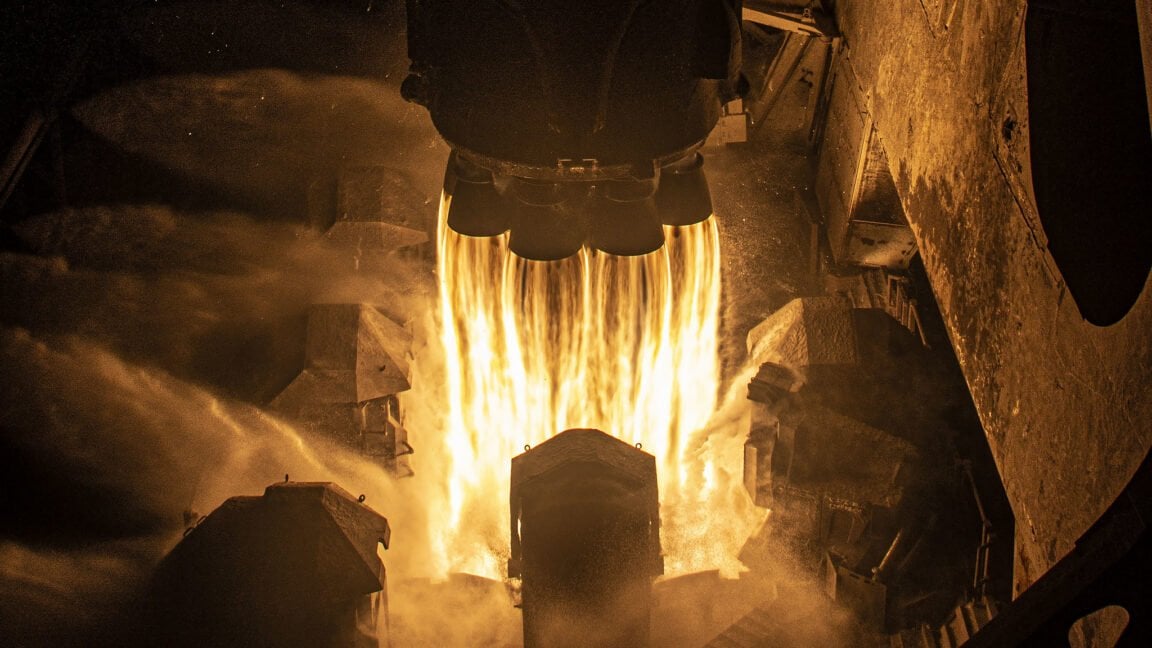
Reusable rockets are here, so why is NASA paying more to launch stuff to space?
https://arstechnica.com/space/2025/04/reusable-rockets-are-here-so-why-is-nasa-paying-more-to-launch-stuff-to-space/

Reusable rockets are here, so why is NASA paying more to launch stuff to space?
https://arstechnica.com/space/2025/04/reusable-rockets-are-here-so-why-is-nasa-paying-more-to-launch-stuff-to-space/
25 Comments
> Kim uses NASA’s pricing data as the benchmark in his paper because the exact costs incurred by launch providers for each flight are proprietary.
And that’s the real reason why nobody has an answer to this, either LSPs are conducting vast amounts of price gouging and have no incentive to renegotiate, or reuse isn’t saving money. I’d lean towards the latter.
SLS is a jobs program. It is doing great on that front
My guess is they signed contracts years ago for X launches at $z/launch, and they’re obligated by the contracts.
Next contract bids will be cheaper, likely.
FWIW, nasa got out of the “cost+” business decades ago because too many contractors would bid low cost to win the contract, and then make up their “losses” with the “+” part. Cost+ also tends not to incentivize keeping costs down.
I found the paper. The paper looks at private launch providers only. Seems like its saying that price isnt decreasing and actually increasing. The paper says the prices decreased from the shuttles to private sector launches, but the prices of private launch providers are not decreasing with time for nasa.
[https://www.sciencedirect.com/science/authShare/S0094576525002115/20250411T083200Z/1?dgcid=author&md5=ddbf26648ccb6b6fa5a0feed9f1317e1&cookieCheck](https://www.sciencedirect.com/science/authShare/S0094576525002115/20250411T083200Z/1?dgcid=author&md5=ddbf26648ccb6b6fa5a0feed9f1317e1&cookieCheck)
The idea that reusable rockets are the way forward is mainly a wish of politicians. It’s leftover group-think from the Nixon era. There isn’t much evidence for it though.
This honestly isn’t that hard to understand if you’ve ever engineered anything. Making a machine durable enough and serviceable enough to be used repeatedly costs more money. The actual servicing of it between launches, thousand of manual checks, months of labor in some cases, costs money. Letting a rocket melt itself or fall into the sea is free.
Consider the Bic pen. Now consider a 1930s fountain pen. The vintage Mont Blanc will need to messed with and refilled daily. Many shirts and ink blotters will be consumed. The Bic just runs perfectly until you throw it away and grab another brand new perfect one. The MB was $50 in 1937. $1000 now. The Bic is $0.60.
Efficiency comes in many forms. If you’re trying to save metal the reusable is good. If you’re trying to save money it usually isn’t. This is why so many car parts can’t be rebuilt anymore…there’s nobody to pay the rebuilders.
Because the reusables are still too explody.
Also, NASA has a clear view of time and cost needed to refurbish between launches. That determines launch schedule and overall required size of launch vehicle *fleet*, which is a critical cost factor that seldom comes up when people on the internet compare price of one-shot vs resuables.
When you build a fleet, you take on an added order of complexity in maintaining all vehicles at the same technology level. The alternative (which we saw with the space shuttle) is that although all the launch vehicles *look* the same to the public, they most emphatically are not.
Example: Columbia’s payload capacity was substantially less than all the shuttles that came after her. There were missions that Columbia just couldn’t fly.
Every new vehicle built (yes, even reusables have to replaced periodically) will have upgrades that older units do not. Decisions must be made to either A> upgrade the older units, or B> keep track of every little difference and take it into account when refurbishing and reusing. or C> A little bit of both.
Any approach adds a dramatic “program cost” to the “per launch” cost as calculated by the experts on the internet. This added program cost is usually cast in the media as a “cost overrun”, with the accompanying political ramifications.
I assume the Gov pays more for things when $ is getting kicked back to members of congress.
Musk just can’t win; given the huge number of Starlink launches, my SWAG is that his COST per pound to LEO on a falcon is about a third of what ULA and Northrop and even Rocketlab are paying to build and launch their competitive launchers. But if he drops the price he charges below the competition’s COST, he gets accused of doing it to kill the competitors, and if he matches the prices they charge so they can put in competitive bids, he gets accused of price gouging. So he’s riding the top of Lafer curve, charging enough below ULA to get as much business as he can handle without interfering with Starlink deployment (the true endgame for F9 until and unless Starship actually works) while still allowing ULA and Blue and ESA and RocketLab (who are the true drivers of the price creep) to stay in business.
One big mistake made by the internet experts comparing reusables today with the space shuttle: The reusables are transportation only.
The shuttle was designed for an era when there was no space station up there. That was going to come later. So the shuttle was a combination launch vehicle and temporary space station.
Everything that NASA wanted people in space to do, they had to do it from the space shuttle itself. That’s why it had a payload bay that could carry a school bus. Which, I note, that none of the reusables can do while carrying half a dozen or more passengers.
Shuttle had a lot of addons that were part of the program and were often included as part of the “per launch” expense, even though only a fraction of the addons could be used in any one mission.
It had a manipulator arm (Built by our bitter enemy, Canada). At one time, there were going to be two. I forget if the second one ever flew, or if it was a target of budget cuts.
Shuttle had space lab – a shirt sleeve environment that could carry and operate a wealth of experiments. It had an airlock leading into the payload bay for use with the various configurations of spacelab.
Shuttle had several equipment options for spacecraft deployment. They could be used for all kinds and sizes of satellites. I know it carried up to (at least) 3 payloads at a time. I think the Hubble was the biggest single payload it ever carried. Some of the deployments went out into the solar system.
It had a computer network for flight, and another one for controlling all science going on. It had airlocks for exposing small experiments to space when they weren’t flying space lab.
It isn’t really meaningful to compare shuttle “per launch” costs with the costs of modern reusables.
Short answer…because that’s how Privatization for profit works, plain and simple.
Acronyms, initialisms, abbreviations, contractions, and other phrases which expand to something larger, that I’ve seen in this thread:
|Fewer Letters|More Letters|
|——-|———|—|
|[BE-4](/r/Space/comments/1k78u6h/stub/mowrqfk “Last usage”)|Blue Engine 4 methalox rocket engine, developed by Blue Origin (2018), 2400kN|
|[ESA](/r/Space/comments/1k78u6h/stub/mowh5b7 “Last usage”)|European Space Agency|
|[GAO](/r/Space/comments/1k78u6h/stub/mowxm89 “Last usage”)|(US) Government Accountability Office|
|[LEO](/r/Space/comments/1k78u6h/stub/mowx2se “Last usage”)|Low Earth Orbit (180-2000km)|
| |Law Enforcement Officer (most often mentioned during transport operations)|
|[LSP](/r/Space/comments/1k78u6h/stub/mow7klk “Last usage”)|Launch Service Provider|
| |(US) [Launch Service Program](https://www.nasa.gov/content/lsp-overview)|
|[NG](/r/Space/comments/1k78u6h/stub/mowbgbi “Last usage”)|New Glenn, two/three-stage orbital vehicle by Blue Origin|
| |Natural Gas (as opposed to pure methane)|
| |Northrop Grumman, aerospace manufacturer|
|[NLS](/r/Space/comments/1k78u6h/stub/mowbgbi “Last usage”)|NASA Launch Services contracts|
|[RD-180](/r/Space/comments/1k78u6h/stub/mowrqfk “Last usage”)|[RD-series Russian-built rocket engine](https://en.wikipedia.org/wiki/RD-180), used in the Atlas V first stage|
|[RP-1](/r/Space/comments/1k78u6h/stub/mowrqfk “Last usage”)|Rocket Propellant 1 (enhanced kerosene)|
|[SLS](/r/Space/comments/1k78u6h/stub/mow93ie “Last usage”)|Space Launch System heavy-lift|
|[ULA](/r/Space/comments/1k78u6h/stub/mowu1mi “Last usage”)|United Launch Alliance (Lockheed/Boeing joint venture)|
|Jargon|Definition|
|——-|———|—|
|[Raptor](/r/Space/comments/1k78u6h/stub/mox5i5e “Last usage”)|[Methane-fueled rocket engine](https://en.wikipedia.org/wiki/Raptor_(rocket_engine_family)) under development by SpaceX|
|[Starlink](/r/Space/comments/1k78u6h/stub/mox5a9j “Last usage”)|SpaceX’s world-wide satellite broadband constellation|
|[cislunar](/r/Space/comments/1k78u6h/stub/mowf298 “Last usage”)|Between the Earth and Moon; within the Moon’s orbit|
|methalox|Portmanteau: methane fuel, liquid oxygen oxidizer|
Decronym is now also available on Lemmy! Requests for support and new installations should be directed to the Contact address below.
—————-
^([Thread #11289 for this sub, first seen 25th Apr 2025, 02:27])
^[[FAQ]](http://decronym.xyz/) [^([Full list])](http://decronym.xyz/acronyms/Space) [^[Contact]](https://hachyderm.io/@Two9A) [^([Source code])](https://gistdotgithubdotcom/Two9A/1d976f9b7441694162c8)
What NASA is charged does not necessarily reflect what it *costs* the launch provider. Right now there is no provider competitive with SpaceX on price (or cadence). So long as they remain reliable, they need *charge* only slightly less than the competitors.
Regarding said cost to SpaceX, this reference is a few years old, but it’s the best I have and can perhaps give insight better than intelligent guessing …
[According to Musk,](https://www.elonx.net/how-much-does-it-cost-to-launch-a-reused-falcon-9-elon-musk-explains-why-reusability-is-worth-it/) the marginal cost of launching a used Falcon 9 (ie, used booster and fairings) is around $15 million. Apparently, refurbishing the booster costs just $250,000.
Cause spacex can’t lower the price without every other company that doesn’t have reusable rockets throwing a hissy fit that they can’t possibly compete, they have no proposals for their own reusable rockets.
SpaceX has no competition. I’m no fan of Musk, but why would he limit his profits when there is no competition?
Prices won’t go down untill more launch providers have reusable rockets. Why should SpaceX drop its prices to be closer inline to their actual cost when their competitors have to charge to build a new rocket for each launch they do?
There is another reason all the space agencies still use ULA. Assured delivery on orbit or assured mission.
While spacex is good at what they do, their mission assurance is almost non existent. They are getting there, but they are usually learning through mistakes. We’ve used them a couple of times for missions I’ve worked, and my launch guy always comes back from meetings with them shaking his head.
Also, falcon heavy is still not capable of launching some deep space missions and starship is not even close to being certified. Blue Origin is as close, in my opinion, to having a viable large, heavy launch capability.
And for what it’s worth, musk isn’t the one that drives spacex. He’s a cheerleader. He is not an engineer or scientist. He reads books and draws conclusions that are usually, but not always, wrong. It’s Gwen that is truly the brains behind the organization. That , and dozens of overworked junior engineers. Most of whom quit after a few years and go to more traditional companies.
There’s no competition in the reusable rocket market, so there is no incentive to lower prices.
>This suggests SpaceX is selling launches at a significant markup, although the Falcon 9’s list price still undercuts the company’s competitors.
And why shouldn’t they?
They can’t increase their market share by dropping their price, since the government requires there be multiple vendors, regardless of cost.
So SpaceX maximizes their profits on whatever portion of the market they are awarded, and the government still gets the lowest cost ride.
It’s a Win-Win-Win. (iykyk).
Hopefully, competition with Blue Origin when they get their rocket to land properly and Rocket Lab’s mid-weight rocket will put dent in the rising costs. SpaceX should be cheaper, it is…but sounds likely rising the prices since they nearly only one in town.
Because single source is bad. Sigh … but avoid Boeing for now. C’mon legacy, catch up. Fix your face.
tl;dr — Because SpaceX’s Falcon 9 is actually the only reusable rocket available, so far.
because nasa is staffed by idiots for the most part which is why they are a space agency with a rich history who can’t even figure out how to build a rocket anymore
Congress crippling their efforts, dragging their heels deliberately to keep a dozen jobs
https://arstechnica.com/science/2021/06/legislation-requires-nasa-to-build-sls-test-article-after-initial-flights/
Profit motive is here. It turns out that even a more efficient process when done for a profit costs more money.
Reddit a couple weeks ago: Oh no trump shouldn’t make nasa cuts this is insane!
Reddit now: dafuq Nasa doing with that money?