
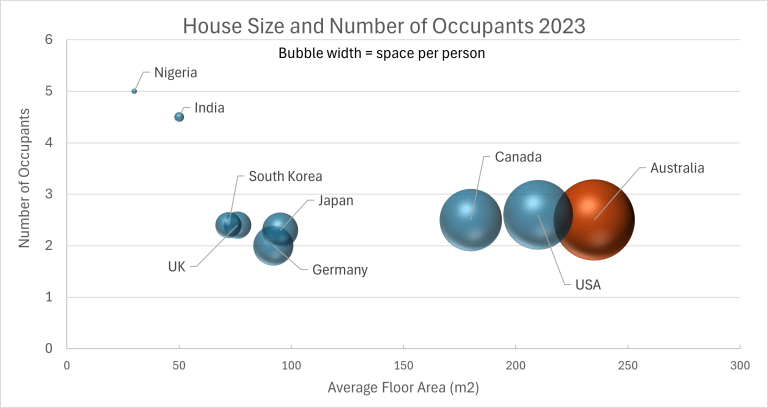
Made in Excel with Data from the following sources:
Australia
• Home size: 235 m² – ABS, https://www.abs.gov.au/articles/average-floor-area-new-residential-dwellings
• Household size: 2.5 – ABS Census, https://www.abs.gov.au/census/find-census-data/quickstats/2021/AUS
United States
• Home size: ~210 m² – U.S. Census, https://www.census.gov/construction/chars/highlights.html
• Household size: 2.6 – U.S. Census QuickFacts, https://www.census.gov/quickfacts/fact/table/US
Canada
• Home size: ~180 m² – StatCan, https://www150.statcan.gc.ca/n1/pub/75-006-x/2020001/article/00008-eng.htm
• Household size: 2.5 – StatCan, https://www150.statcan.gc.ca/n1/daily-quotidien/220727/dq220727b-eng.htm
United Kingdom
• Home size: 76 m² – BBC/UK Housing, https://www.bbc.com/news/uk-14921661
• Household size: 2.4 – ONS, https://www.ons.gov.uk
Germany
• Home size: 92 m² – Eurostat, https://ec.europa.eu/eurostat
• Household size: 2.0 – Destatis, https://www.destatis.de/EN
France
• Home size: ~91 m² – Deloitte Property Index, https://www2.deloitte.com/ce/en/pages/real-estate/articles/property-index.html
• Household size: 2.2 – INSEE, https://www.insee.fr/en/statistiques
Japan
• Home size: 95 m² – Real Estate Japan, https://resources.realestate.co.jp
• Household size: 2.3 – OECD, https://data.oecd.org/people/household-size.htm
South Korea
• Home size: ~72 m² – KOSIS, https://kosis.kr/eng/
• Household size: 2.4 – OECD, https://data.oecd.org/people/household-size.htm
India
• Home size: ~50 m² – Economic Times, https://economictimes.indiatimes.com
• Household size: 4.5 – World Bank, https://data.worldbank.org/indicator/SP.HOU.FAML.ZS?locations=IN
Nigeria
• Home size: ~30 m² – UN Habitat (est.)
• Household size: 5.0 – ArcGIS, https://www.arcgis.com/home/item.html?id=fbb3c5c5fa9f4429be56af8b11ef4643
Posted by LivingMoreWithLess
11 Comments
Maybe if you are counting the places in the back of Burke and northern territories where there is a 1000sqm house and you average them with the Sydney apartments…… otherwise it doesn’t make sense
Do these numbers include basements? A cursory google search indicates that they typically don’t count towards the floor area. I would caution just comparing these numbers because different countries might count floor area differently. A cursory google search indicates that basements are often not counted towards floor area.
Australian houses very rarely have basements. It’s just not necessary here because it never freezes in most of the populated part of the country, so you can place stuff like hot water systems just outside.
Compared to Canada and the US where basements are more common, Australian homes might just have a bit more floor area to make up for the lack of a basement.
What not bubble area is area? This graphic shows the square of the area so radically exaggerates the differences.
Thats because they have a huge amount of land for a relatively reduced population when compared to other regions. I remember that a friend of mine went to Australia to work in a farm taking care of different animals and the size of the land was similar to the entire small town where he lived…it was just crazy 😂😂
Whether it is an apartment (multi-family housing) or a detached house will be a major factor. If you compare detached houses, the difference will be somewhat smaller.
Bubble width is space per person? With no legend it’s really impossible to tell what it is, but this is the most important stat! I don’t want to see house size, just space per person!
Your BBC link is dead too.
When you have nothing but open space, people tend to start using a lot of it.
cubes may be a better visual, but I do like that you tried to show some dimension with spheres
Would love to see this stat in actual CBD’s cause it’ll be way different for Australia. You are including rural properties which are enormous.
Damn I had to come to the comments and read several before I realized this was not about horses
Really changes perspective there
It’s worth noting that dwelling area includes garages and balconies/decks in Australia which may skew the data.