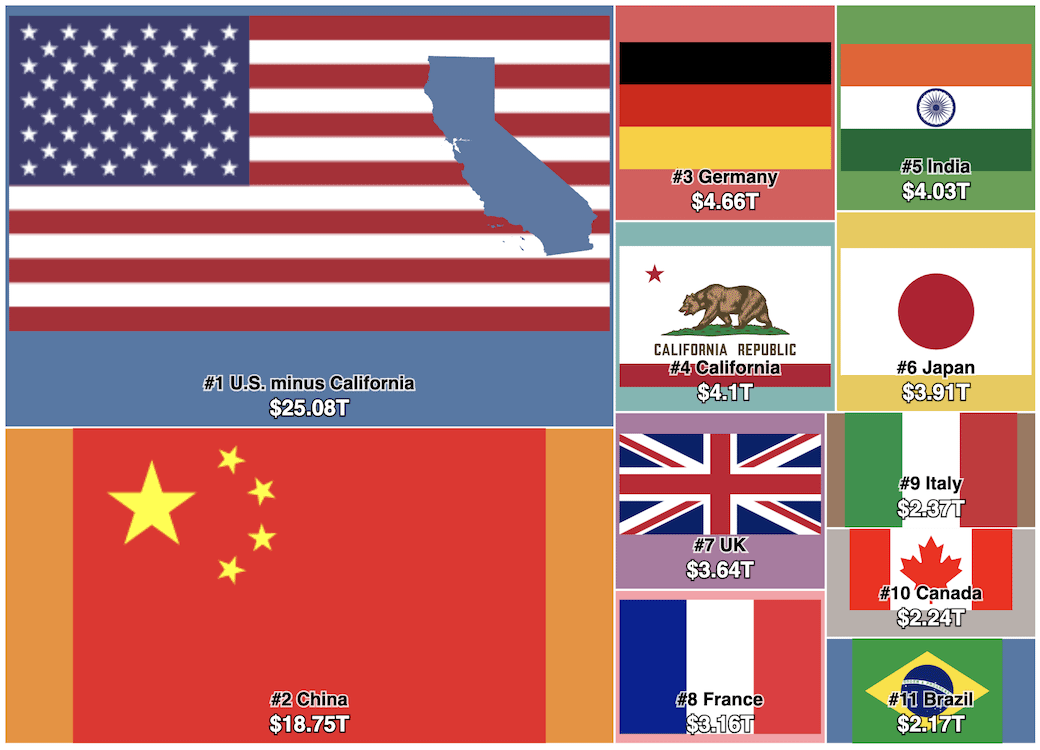
[OC] California would be the world’s 4th largest economy if it were a separate country – Treemap showing the top 10 world economies with California.
Posted by EngagingData

![[OC] California would be the world's 4th largest economy if it were a separate country - Treemap showing the top 10 world economies with California.](https://www.byteseu.com/wp-content/uploads/2025/05/Ok-xbDYWqGY0QVRJoF7W1ZDi5cfZIhEeClb5Fch_bok-1024x738.png "[OC] California would be the world’s 4th largest economy if it were a separate country – Treemap showing the top 10 world economies with California.")
[OC] California would be the world’s 4th largest economy if it were a separate country – Treemap showing the top 10 world economies with California.
Posted by EngagingData
20 Comments
California wouldn’t be the 4th largest country because it’s wealth as a state is because it’s a part of the USA
Interactive treemap showing California’s place in the top 10 world economies (including the US with California removed). I had made a visualization a few years ago when the state was the 5th largest economy and 2024 data changed that to 4th. The State also has the smallest population in the top 10 as well as the largest GDP change by percentage (largest absolute change as well, except for US) since 2022.
This is not meant to promote the idea that California should leave the US. Just trying to show the relative strength of the California economy.
**Sources and Tools:**
2024 economic data was downloaded from the International Monetary Fund (IMF). This visualization is made using d3.js, an open-source javascript visualization library, javascript, HTML and CSS.
The United States GDP is bigger than all of EU + UK combined
Crazy how China’s GDP is on track to pass the US, considering it was so far behind just a couple decades ago.
This is assuming California could maintain their relative economic strength without the support of the nation. They’d definitely be an economic powerhouse but something like secession would absolutely destroy their stability and they’d drop in ranking pretty much immediately
But most people in California could still not afford to buy a house and face bankruptcy when they get sick,
It’s not true, if you separate California from the resources and market that the US provides it it couldn’t be what it is now.
california wouldn’t have access to all its resources if its a separate country
Wild how California is ahead of India….most populated country on earth
wild! Apparently the population of CA would put it at the 38th most populous country in the world. It has ~40 million people, similar to the entire population of Canada or Australia.
Just waiting for California and Oregon and Washington to secede and join Canada. Could be the #3 Economy.
Turns out having an immigrant minority slave class is quite the economic driver.
Just think what it could be if the left wasn’t actively trying to kill every industry in the state.
There is a war on energy, farming, fishing, manufacturing and more.
California is a power house in spite of what the government does, not because of it.
Healthcare GDP spending in US would be 3rd (5T)
This means nothing since the state is habitually in debt and keeps driving away its most successful entrepreneurs through over-regulation and excessive taxation.
Until/Unless there is a total and utter collapse of the federal government, it won’t happen. Last thing D.C. wants is the sudden creation of a new nuclear power, and there ain’t no way we’d give up the one thing that would keep D.C. from attacking us.
4th largest economy. And second largest (sub-sovereign) debt in the world.
If it were a separate country is going to do a lot of heavy, distorted, lifting here.
Silly to carve out one state and not the other two states that would also be top ten individually, in Texas and NY.
4th largest economy in the world
Number 1 in the nation for the most expensive gallon of gasoline ($4.78)
GDP ≠ The Economy, why there is a huge disconnect: most Economic organisations use GDP adjusted to Purchasing Power Parity (PPP) to measure the size of economies, especially for such comparisons, the World Bank, OECD, Bruegel, WEF etc., the IMF sits on the fence. PPP adjusts to price level/cost of living between countries and corrects for exchange rate fluctuations because basic nominal GDP not only measures economic output but prices, so raw GDP will soar from higher and higher prices.
[The World Bank](https://en.wikipedia.org/wiki/List_of_countries_by_GNI_(PPP)_per_capita#Purchasing_Power_Parity_(PPP)) explains it:
>Typically, higher income countries have higher price levels, while lower income countries have lower price levels ([Balassa–Samuelson effect](https://en.wikipedia.org/wiki/Balassa%E2%80%93Samuelson_effect)). Market exchange rate-based cross-country comparisons of GDP at its expenditure components reflect both differences in economic outputs (volumes) and prices. Given the differences in price levels, the (economic) size of higher income countries is inflated, while the size of lower income countries is depressed in the comparison. PPP-based cross-country comparisons of GDP at its expenditure components only reflect differences in economic outputs (volume), as PPPs control for price level differences between the countries. Hence, the comparison reflects the real (economic) size of the countries.
[OECD](https://www.oecd.org/en/data/insights/data-explainers/2024/06/purchasing-power-parities—frequently-asked-questions-faqs.html#PPPs3): ‘The major use of PPPs is as a first step in making inter-country comparisons in real terms of gross domestic product (GDP) and its component expenditures. Calculating PPPs is the first step in the process of converting the level of GDP and its major aggregates, expressed in national currencies, into a common currency to enable these comparisons to be made.” (OECD is made up of 38 mostly western countries)
[Bruegel:](https://www.bruegel.org/analysis/european-unions-remarkable-growth-performance-relative-united-states)”The right metric for international comparisons is purchasing power parity (PPP)-adjusted output. This corrects for exchange rate fluctuations and differences in various national prices.” (18 European member countries and dozends of Financial institutions and Corporate members)
On top of this, the Usa has a rather small informal economy, at around 8% of GDP (Formal economy), in most of the world it’s 25-35% of GDP (World Bank data). **Sorry for long Text!**