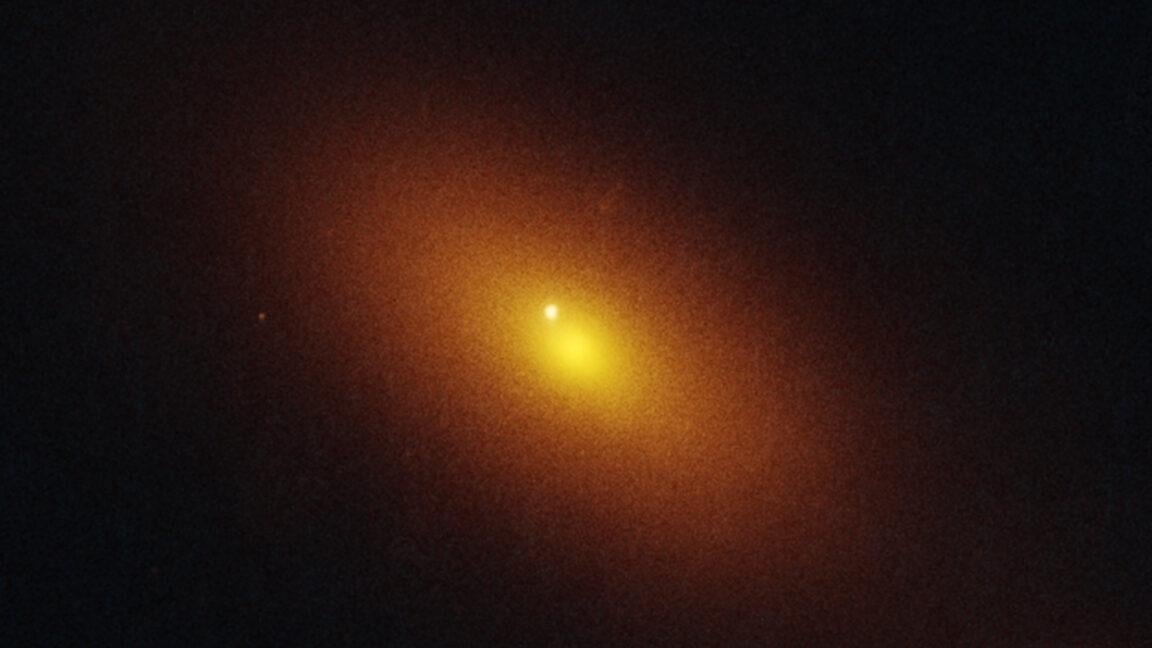
A star has been destroyed by a wandering supermassive black hole | Second supermassive black hole is a long way from the galaxy’s core.
https://arstechnica.com/science/2025/05/a-star-has-been-destroyed-by-a-wandering-supermassive-black-hole/

A star has been destroyed by a wandering supermassive black hole | Second supermassive black hole is a long way from the galaxy’s core.
https://arstechnica.com/science/2025/05/a-star-has-been-destroyed-by-a-wandering-supermassive-black-hole/
3 Comments
What’s scarier, it taking out the sun first, or taking out the earth first.
Astronomer here! I study this sort of thing for a living, and was involved with some of the first radio observations of this source!
A [Tidal Disruption Event (TDE)](https://en.wikipedia.org/wiki/Tidal_disruption_event) occurs when a star wanders too close to a supermassive black hole, and gets torn apart by tidal forces. The process takes a few hours to unbind the star, and when this happens half the stellar material gets flung outwards, and half goes into orbit around the black hole in an accretion disk- very little falls into the black hole itself.
Now the trouble with finding TDEs is that they’re VERY rare- maybe one in a million years in a galaxy like ours levels of rare. Further, the black holes that do this are of a specific size for physics reasons- a supermassive black hole (SMBH) which is about a million to 100 million times the mass of our sun. These SMBHs are almost always at the centers of galaxies- basically every large galaxy has one- so to date all TDEs found were in SMBHs at the galactic centers.
Until this event, AT2024tvd! It was a TDE detected *off center* from its galactic center, causing considerable interest in the astronomical community. It’s still a masssive SMBH- 100 million times the mass of our sun- but is there in addition to the SMBH at the galactic center. So that’s exciting- until the TDE happened we had no way of detecting this black hole! How did it get there? We aren’t totally clear but a leading theory is there was a merger of two galaxies at some point earlier, leading to one galaxy with two SMBHs. Eventually it’ll probably merge with the other one.
Anyway I LOVE TDEs so happy to answer any questions folks have on this event or any others! I also wrote [this article](https://www.astronomy.com/science/how-do-black-holes-swallow-stars/) about TDEs for *Astronomy* a few years back, and am just sending back edits to *Scientific American* on a piece about them for their July/August issue, which will be out next month!
That star got a one-way ticket to the cosmic recycle bin.